
Join Zafar Masud, survivor of the tragic PIA plane crash, for a profound session at the 11th Hyderabad Literature Festival. In this 50th international talk, Masud dives deep into his bestseller, Seat 1C, sharing the raw “30 seconds of life before death” that redefined his existence. From the necessity of candid communication to the weight of survivor’s guilt and the failure of social ecosystems, Masud offers a rare, first-hand perspective on accountability and leading with empathy.
The Power of Narrative and Survival at the 11th Hyderabad Literature Festival
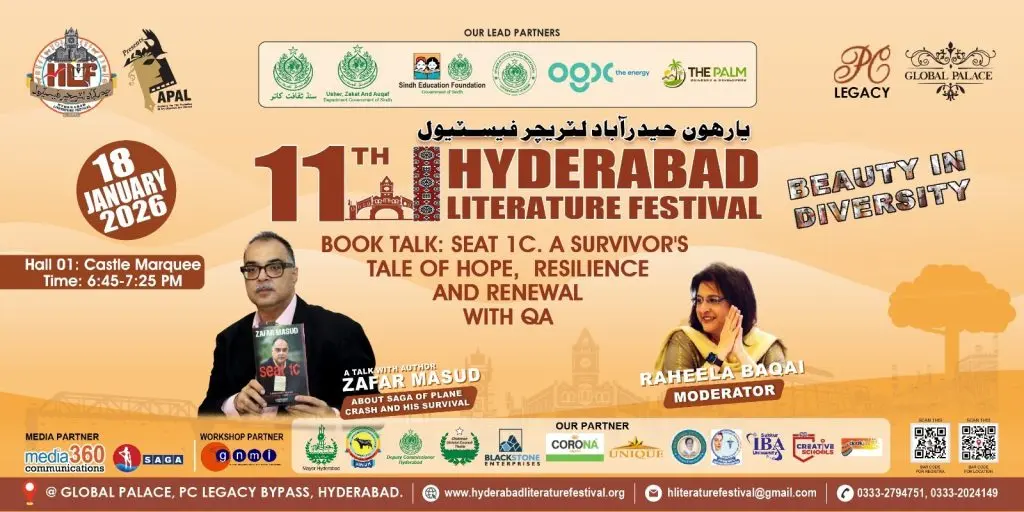
The intersection of literature, survival, and profound life lessons took center stage at a recent gathering that has become a cornerstone of the cultural calendar in Sindh. The 11th Hyderabad Literature Festival served as the prestigious backdrop for a deeply moving discourse by Zafar Masud, a man whose name has become synonymous with resilience following his miraculous survival of the PIA plane crash. This milestone event, marking over a decade of intellectual exchange, provided a platform for Masud to share the philosophy behind his international bestseller, “Seat 1C,” and to reflect on the transformative power of the written word.
A Vision for Cultural Expansion
The talk commenced with a heartfelt tribute to the organizers of the 11th Hyderabad Literature Festival, particularly Izhar Sumro, whose dedication has sustained this vital gathering for eleven consecutive years. Masud emphasized that such events are not merely social gatherings but are essential intellectual lifelines for the smaller cities of Pakistan. He expressed a strong desire to see this model replicated across the province, suggesting that the spirit of the 11th Hyderabad Literature Festival should be carried to cities like Nawabshah and Sukkur.
The speaker noted that fostering a culture of reading and dialogue in these regions is paramount for social development, and he pledged his maximum support for such future endeavors. By acknowledging the hard work of the organizing committee, including Rahila, Masud highlighted the collaborative effort required to maintain the high standards of the 11th Hyderabad Literature Festival.
The Global Journey of “Seat 1C”
One of the most remarkable aspects of the 11th Hyderabad Literature Festival was the revelation of the book’s global footprint. Masud shared that while the talk at the 11th Hyderabad Literature Festival was his 50th, the journey of “Seat 1C” had already spanned continents, including successful launches in Dubai, the UK, the USA, Hong Kong, and Macau. The book has officially reached the status of an international bestseller, with over 5,000 copies sold through both local and international publishers.
The literary reach of Masud’s narrative continues to expand, with a Spanish translation already released and an Urdu version currently in progress, translated by the esteemed Dr. Amjad Saqib. Discussions are also underway for French and Chinese editions. This global resonance underscores the universal nature of the themes discussed during the 11th Hyderabad Literature Festival, proving that the story of survival and human learning transcends linguistic and geographical boundaries.
A Legacy Beyond the Transitory World
A central theme of the 11th Hyderabad Literature Festival book talk was the motivation behind choosing a book as the primary medium for this story. In an era dominated by fleeting digital content, Masud argued for the enduring “shelf life” of physical books. He viewed the publication of “Seat 1C” as a permanent contribution to a transitory world—a legacy of creativity that he wishes to leave behind. For Masud, the structure of a book provides a unique space for reflection, free from the constraints of time and space found in other media.
Furthermore, he touched upon the “writing DNA” of his family, noting that his extended family has produced nearly 50 books across generations. This personal history added a layer of depth to his appearance at the 11th Hyderabad Literature Festival, as he positioned his work within a broader familial tradition of intellectual contribution. His goal remains to encourage a renewed habit of reading among the public, using his unique story to pull readers back toward the contemplative world of literature.
The Philosophy of Life Before Death
Perhaps the most gripping segment of the 11th Hyderabad Literature Festival book talk was Masud’s exploration of what he calls “the 30 seconds of life before death.” While many religious and philosophical traditions focus on the afterlife, Masud used the 11th Hyderabad Literature Festival to pivot the conversation toward the intense accountability and clarity found in the final moments of existence. He described how his entire life flashed before him during the crash, from his childhood in Lahore to his professional achievements.
In those critical seconds, he felt he was standing in his own dock, answering for how he had treated his loved ones and lived his life. He shared a profound sense of peace, noting that he had no regrets and was ready to meet his Creator. This realization led to one of his core learnings: the importance of living a life so intentional and compassionate that one can face the end without the burden of regret. By sharing this intimate psychological journey at the 11th Hyderabad Literature Festival, Masud provided the audience with a rare perspective on human mortality and the value of every living second.
The Intersection of Art and Professionalism
Masud dedicated a significant portion of his 11th Hyderabad Literature Festival book talk to the concept of communication, which is the focus of the ninth and tenth chapters of his book. He argued that the influence of literature, art, and culture is not just a personal luxury but a professional necessity. According to Masud, these disciplines provide the “essence” needed to understand cultural realities and solve complex problems. At the 11th Hyderabad Literature Festival, he explained how groundedness in one’s own language and culture allows for a more empathetic and effective leadership style.
He also addressed the tragic consequences of communication failures, referencing the pilot’s failure to announce stress during the crash. By citing philosophers like Plato and poets like John Elia and Rumi, Masud illustrated how truth and beauty are intertwined in effective communication. He urged the attendees of the 11th Hyderabad Literature Festival to embrace the complexities of poetry and history to better understand their own social and economic systems.
Forgiveness as a Path to Peace
The final major learning shared before the conclusion of the main talk involved the power of forgiveness. Masud observed that human beings often become entangled in small, local issues—be they religious, linguistic, or social. He argued that the path to a peaceful “30 seconds before death” lies in the ability to forgive both others and oneself. He posited that if an individual can find the strength to forgive their own mistakes in this life, they can approach the afterlife with a sense of grace.
The 11th Hyderabad Literature Festival book talk concluded with a poignant couplet from Javed Akhtar, emphasizing that life is a process of getting entangled and resolved, of scattering and then shining. This poetic finale resonated deeply with the spirit of the 11th Hyderabad Literature Festival, leaving the audience with a message of hope and resilience. Through his narrative, Zafar Masud successfully bridged the gap between a harrowing personal tragedy and a universal blueprint for a meaningful life, ensuring that his contribution to the 11th Hyderabad Literature Festival would be remembered as a landmark session in the event’s history.
The 11th Hyderabad Literature Festival served as a profound platform for intellectual discourse, cultural celebration, and deep introspection. Among the many sessions that graced this year’s event, few were as emotionally charged and philosophically rich as the talk featuring Zafar Masud, the President of the Bank of Punjab and one of the two miraculous survivors of the PK8303 plane crash. While the main session focused on his book, Seat 1C, it was the Question and Answer session that truly unveiled the raw, unscripted humanity of the survivor.
The audience at the 11th Hyderabad Literature Festival engaged Masud not just as a corporate leader or an author, but as a man who had walked through the valley of the shadow of death and returned with lessons that transcend the ordinary.
Question and Answer Session
The 11th Hyderabad Literature Festival Q&A session (which is often the most dynamic part of any literary event) transformed into a communal therapy session of sorts, where societal grievances, personal fears, and existential inquiries were laid bare. The questions ranged from the technicalities of the crash investigation to the spiritual weight of survival, and Masud’s responses were characterized by a rare candor. He did not hide behind corporate jargon or rehearsed platitudes; instead, he offered answers steeped in vulnerability and a newfound wisdom.
Accountability and Systemic Failure
The Question
The first question of the 11th Hyderabad Literature Festival came from Amjad Memon, a resident of Hyderabad. His query touched upon a nerve that runs deep in the Pakistani collective consciousness: the lack of accountability.
Memon pointed out that it had been several years since the tragic incident, yet for the common citizen, the conclusion of the tragedy remained murky. He asked for education and clarity regarding the probe and the inquiry. specifically wanting to know who was ultimately at fault. Was it solely the pilot? Was it the system? Or was there another entity to blame? The underlying frustration in his voice reflected the sentiments of a nation tired of tragedies that seem to occur without consequence or closure.
The Answer
Zafar Masud’s response to this inquiry was multifaceted, moving beyond the simple assignment of blame to a broader critique of the societal structure. He acknowledged that an official report had indeed been released and that it contained elements of accountability, specifically pinpointing the pilot’s error. He noted that the pilot, having lost his life in the crash, had already paid the ultimate price. However, Masud refused to let the conversation end at the feet of a dead man.
He argued passionately that attributing such a catastrophe to a single individual or even a specific institution is a reductionist view that fails to address the root cause. Masud introduced the concept of an “ecosystem of failure.” He posited that the crash was not an isolated event but a symptom of a much larger malady affecting the social, economic, and value systems of the country. He spoke about the “rigidity of rituals” and the collective failure of the society to demand and uphold standards.
At the 11th Hyderabad Literature Festival, Masud’s voice carried the weight of a survivor who sees the tragedy as a recurring cycle. He pointed out the chilling pattern that such aviation disasters seem to happen every ten years, suggesting that this periodicity is a result of the society adjusting to mediocrity and failing to learn. He emphasized that the failure belongs to everyone—the social system, the economic system, and the value system.
By blaming only the pilot, society absolves itself of the responsibility to fix the underlying rot. His purpose in writing Seat 1C and speaking at events like the 11th Hyderabad Literature Festival is to keep the conversation alive, to force people to ask “why” continuously, and to prevent the comfort of amnesia from setting in. He urged the audience to look into their own “collars” (a metaphor for self-introspection) and realize that true accountability begins with a collective refusal to accept systemic failure.
Recurring Trauma and Seat 1C
The Question
The second question was posed by Intizar Soomro, who asked a question that was both literal and symbolic. He inquired about the specific seat number that has now become the title of Masud’s book: Seat 1C. Soomro asked if Zafar Masud had ever used Seat 1C again after the accident. Furthermore, he wanted to know if sitting in that specific seat or traveling, in general, evoked fear or trauma. It was a question about the lingering ghosts of the crash and whether the survivor had truly conquered the specific triggers associated with his near-death experience.
The Answer
Masud’s answer was surprisingly pragmatic and devoid of the superstition that one might expect. He revealed that he has sat on Seat 1C many times since the crash. He clarified that he does not have a specific preference or condition to sit there, nor does he avoid it. If the seat is assigned to him, he takes it; if not, he sits elsewhere. There is no “myth” or mystical significance attached to the physical chair anymore.
His reasoning was grounded in a fatalistic yet comforting faith. He expressed his firm belief that death is an appointed time. If one’s time has come, it does not matter which seat they are occupying—death will find them. Conversely, if it is not their time, they will survive regardless of the circumstances. This philosophy has liberated him from the fear of flying or specific seating arrangements.
By stripping the seat of its power to induce fear, Masud demonstrated a psychological resilience that resonated with the audience at the 11th Hyderabad Literature Festival. He effectively communicated that trauma is often bound to our perception of control, and by surrendering the illusion of control to a higher power (destiny), he has found peace in travel.
Survivor’s Guilt and Economic Disparity
The Question
Salar, an attendee of the 11th Hyderabad Literature Festival who had evidently done his research, brought up a concept Zafar Masud had mentioned in a previous interview: “survivor’s guilt.” Salar asked Masud to elaborate on this psychological phenomenon, specifically in the context of the economy. He referenced the book’s themes of goodness, communication, and sincerity, asking how the guilt of surviving while so many others perished connects to Masud’s views on economic disparity and his professional role. This question sought to bridge the gap between the personal emotional aftermath of the crash and the broader socio-economic responsibilities Masud holds as a banker and leader.
The Answer
To answer this deep and complex question, Zafar Masud turned to his book, Seat 1C, reading directly from the text to ensure he conveyed the sentiment accurately. He paused the live interaction to park the thought and retrieve the specific passage from pages 209-210, highlighting the importance he places on the written word.
Masud redefined survivor’s guilt not as a crippling emotion, but as a driving force for positive change. He read that this guilt has been his “primary motivation for creating a more equitable world.” He challenged the audience at the 11th Hyderabad Literature Festival to rethink the negative associations usually linked with guilt. Instead, he proposed that if individuals view their privileges—be it wealth, position, or health—as proof of their “survival” in an uneven and unjust world, then they should feel a degree of guilt.
However, this guilt should not lead to paralysis. It should propel them to make changes. For Masud, the fact that he survived when others didn’t is a stark reminder of the inequality of fate, which mirrors the economic inequalities in society. His survival has burdened him with the responsibility to level the playing field where he can. This powerful reframing transformed the concept of “survivor’s guilt” into “survivor’s responsibility.” It was a call to action for the elite and the privileged to recognize their status not just as luck, but as a mandate to serve the less fortunate.
Post-Survival Reaction and Fame Management
The Question
A young female member of the audience “Atlas” asked a poignant question regarding the aftermath of the survival. She focused on the “post-survivor reaction” and the societal pressure that comes with being a “miracle.” Atlas asked about Masud’s feelings immediately upon realizing he was alive and how he dealt with the stigma or the overwhelming attention from society.
Atlas pointed out that in our society, victims or survivors are often pointed at, whispered about (“He is the one who survived”), and their families are scrutinized, which can drive a person into depression. Atlas wanted to know how long it took for Masud to be able to face an audience and speak so openly, and how he managed the sudden, often invasive, fame.
The Answer
Zafar Masud’s response was one of the most storytelling-driven segments of the session at the 11th Hyderabad Literature Festival. He began by addressing the immediate reaction to survival, sharing a spiritual experience that occurred during the crash itself. He described a dialogue with God as the plane was going down. He had surrendered, telling God, “I am looking forward to seeing You.” In that moment of complete submission, he heard a voice—an internal intuition or a divine message—telling him, “It will be all right.” When he argued that the crash was inevitable, the voice clarified: “The plane will crash, but you will survive.”
Because of this premonition, when he woke up in the hospital, he was not surprised. He had already been told he would survive. This spiritual conviction shielded him from the initial shock.
He then transitioned to the “fame management” aspect by recounting a humorous and touching anecdote about calling his father, the famous actor Munawar Saeed. Upon reaching the hospital, Masud’s only concern was his loved ones. He called his father, who picked up the phone with his characteristic calm. When Masud said, “The plane crashed, and I am in the hospital,” his father, perhaps thinking it was a minor accident or in a state of shock, simply asked where he was and said family was on the way.
It was only later that his father revealed the surreal nature of that call; he had been praying with the same conviction that his son would survive, and when the phone rang, it was a confirmation of faith, yet a moment where reality and hope blurred.
On the topic of fame, Masud was humble. He noted that coming from a family of celebrities (his father and extended family), he was already accustomed to the mechanics of fame. Furthermore, he credited his friends and family for keeping him grounded. He specifically mentioned his friend Atif Bari, present in the audience, as someone who ensures he never gets a “swollen head.” Masud’s answer highlighted that a strong support system is crucial for mental health, preventing the survivor from being consumed by the public persona society tries to impose.
Privilege, Class, and Voicing Tragedy
The Question
Dr. Rizwana Ansari asked perhaps the most challenging question of the 11th Hyderabad Literature Festival evening, striking at the heart of class privilege in Pakistan. She acknowledged Masud’s position as the President and CEO of the Bank of Punjab and noted that he was sitting there sharing his story. She then asked: “Is it possible that a survivor of the Jaffar Express accident (a train accident often affecting the working class) could sit here and tell their story like you?” The implication was clear: Was Masud’s platform a result of his survival, or his socio-economic status?
The Answer
Zafar Masud did not dodge the uncomfortable nature of the question. He accepted the premise that his position might play a role in the invitations he receives. However, he countered with a powerful point about agency and effort. He asked, “How many people from the Jaffar Express have written a book?”
His point was not to dismiss the lack of opportunity for the poor, but to highlight that telling one’s story requires an immense personal effort that goes beyond social status. He explained that writing Seat 1C and speaking about the trauma is not an easy task that his status simply “grants” him. It is a grueling emotional labor. He revealed that he underwent four months of mental health treatment after the crash and continues to see a therapist weekly because every time he retells the story—like he was doing at the 11th Hyderabad Literature Festival—it takes a toll on his mind.
He argued that there is a negativity in society that seeks to discredit individual effort by attributing everything to privilege. He emphasized that he does not need to use his book to get screen time; as a bank president, he could easily command an hour of airtime to talk about the economy without the emotional pain of revisiting his near-death experience.
He chooses to speak about the crash not for fame, but because he feels a duty to share the lessons of “30 seconds before death.” He urged the audience to give credit where it is due: writing a book and baring one’s soul is a struggle for anyone, regardless of their bank balance. This response was a defense of the human struggle behind the corporate title.
Divine Purpose and Good Deeds
The Question
Shamshad Ali, a head teacher from Hyderabad, asked a question steeped in traditional religious morality. He expressed joy at Masud’s survival and then asked if Masud believed that his survival was a reward for some specific good deed, such as serving his mother or a hidden act of kindness. This is a common narrative in Pakistani culture—that miracles are transactions for past virtues.
The Answer
Masud’s answer was a lesson in humility. He flatly rejected the idea that he was saved because of his own virtues. “I don’t know the reason for my survival,” he admitted, adding that he doesn’t even want to find out. He dismantled the “saintly survivor” trope, stating clearly that he is not a Maulana, nor a philanthropist like Edhi or Adib-ul-Hasan Rizvi. He described himself as a regular person who is not overly religious in the ritualistic sense.
If there was any reason, he speculated, it might be the prayers of his parents. He attributed his life to their “Sadqa” (charity/sacrifice) and God’s desire not to inflict the pain of losing a child upon them during their lifetime. He refused to take credit for his survival as a badge of his own morality. Instead, he pivoted back to the idea of responsibility.
Regardless of why he was saved, the fact remains that he was saved, and therefore he has a duty to share his experience. He reiterated that his mission is to prepare people for those “30 seconds before death,” helping them live a life that leaves no room for regrets, so that when they face their Creator, they are ready.
Writing Challenges and Corporate Leadership
The Question
The final set of questions of the 11th Hyderabad Literature Festival came from a young man named Anand. He asked two distinct questions. First, what was the most painful part of writing the book, considering it involved reliving a personal tragedy? Second, how did this traumatic experience shape Masud’s corporate leadership style?
The Answer
Due to time constraints at the 11th Hyderabad Literature Festival, Masud answered these concisely but effectively. On the topic of writing, he acknowledged the immense pain involved in the process, reinforcing his earlier point to Dr. Rizwana about the mental toll of the narrative.
On the topic of leadership, Masud identified “empathy” as the cornerstone of his management philosophy. He stated that his leadership style has always been “Management by Empathy,” but the crash reinforced this belief significantly. Seeing the fragility of life confirmed for him that people are the most important asset in any situation. Whether in a corporate boardroom or a disaster zone, human connection and understanding are paramount.
The experience of the crash stripped away the superficial layers of professional hierarchy, leaving only the human element. He carried this lesson back to the Bank of Punjab, viewing his employees and customers not just as numbers, but as human beings with their own “30 seconds” ahead of them. This reinforcement of empathy has become his hallmark, blending the decisiveness of a CEO with the compassion of a survivor.
The 11th Hyderabad Literature Festival
The cultural heart of Sindh beat with renewed vigor this week as the 11th Hyderabad Literature Festival unfolded at the Global Palace. This annual gathering has become a cornerstone of the regional intellectual calendar, drawing together a diverse array of scholars, artists, and literary enthusiasts to celebrate the “Beauty in Diversity.”
A Grand Inauguration and Cultural Awakening
The festival was formally inaugurated by the Sindh Culture Minister, Syed Zulfiqar Ali Shah, who emphasized that the province has always been a beacon of peace and coexistence. The opening ceremony set a high bar for the proceedings, beginning with a soulful recital of Shah Abdul Latif Bhittai’s wai by renowned singer Anu Solangi. This was followed by a vibrant Gilgiti dance performed by students from Sindh Agriculture University, perfectly encapsulating the spirit of the 11th Hyderabad Literature Festival and its commitment to cross-cultural exchange.
One of the most significant highlights of the first day was the focus on the “Boreendo,” an ancient musical instrument from the Indus Valley Civilization. Recently granted UNESCO World Heritage status, the instrument was expertly tuned and played by Malhar Junejo, offering the audience a literal echo of 5,000 years of history.
Intellectual Discourse and “Beauty in Diversity”
Guided by the theme “Beauty in Diversity,” the event featured over 40 sessions covering literature, archeology, politics, and technology. Keynote speaker Haris Khalique delivered a moving address, urging the intellectual community to bridge societal divides. He noted that while adhering to individual civilizational assets is vital, promoting “friendly voices” is the only way to ensure the survival of local culture in a globalized world.
The 11th Hyderabad Literature Festival also served as a critical platform for discussing modern media challenges. In the session “Sahafat Ka Aangan Tera,” senior journalist Mazhar Abbas critiqued the current shift toward sensationalism, lamenting the lack of prime-time discourse on fundamental issues like water scarcity and public health. This balance of cultural celebration and hard-hitting social critique is what defines the festival’s unique character.
Literary Highlights and Book Launches
The event was a paradise for bibliophiles, featuring the launch of eight new books. Notable sessions included:
- An exclusive look into Farhatullah Babar’s latest work.
- A multilingual poetry symposium featuring Sindhi, Saraiki, Urdu, and Punjabi verses.
- Discussions on the past dynasties of Sindh—Samma, Soomra, Kalhora, and Talpur—to educate the youth on their heritage.
Honoring Excellence: Lifetime Achievement Awards
In a tradition that celebrates the giants of Pakistani art and letters, the 11th Hyderabad Literature Festival conferred lifetime achievement awards upon six distinguished personalities. The recipients included:
- Naseer Mirza (Broadcaster and scholar)
- Sakina Samoon (Acclaimed actress and director)
- Humera Channa (Legendary playback singer)
- Samina Ahmed (Veteran actress)
- Wusatullah Khan (Senior journalist and columnist)
- Afzal Ahmed Syed (Renowned poet)
The recognition of these figures highlights the festival’s role in preserving the “soft image” of Pakistan while honoring those who have dedicated their lives to the country’s cultural enrichment.
Impact and Legacy
Organizer Izhar Soomro expressed satisfaction with the festival’s growth, noting that the event provides a safe, inclusive environment for women and youth to engage with global ideas. As the two-day event culminated with musical performances by Ahmed Jahanzaib and Faheem Ali, it left behind a legacy of dialogue and a renewed sense of pride in Sindh’s pluralistic roots.
Literary Festivals in Pakistan
The landscape of Pakistani literature has undergone a remarkable transformation over the last two decades. What began as a singular, pioneering effort in Karachi has blossomed into a nationwide “bonfire of festivals” that illuminates the country’s intellectual and cultural heritage. These gatherings have become essential sanctuaries for dialogue, critical thinking, and the celebration of linguistic diversity in an increasingly digital world.
The resurgence of the reading culture in Pakistan is anchored by several flagship events that draw international scholars, Nobel laureates, and thousands of local book lovers annually.
1. Karachi Literature Festival (KLF)
Launched in 2010, the Karachi Literature Festival is the “mother” of all literary festivals in Pakistan. Now in its 17th edition (February 2026), it traditionally transforms the Beach Luxury Hotel into a hub of intellectual fervor. With themes like “Narratives from the Soil,” KLF bridges the gap between indigenous voices and global narratives.
2. Lahore Literary Festival (LLF)
Often described as one of South Asia’s premier cultural events, the Lahore Literary Festival (held at the Alhamra Arts Center) is renowned for its academic depth and aesthetic elegance. It has played a pivotal role in Lahore being recognized as a UNESCO City of Literature.
3. Islamabad Literature Festival (ILF)
Managed by Oxford University Press, ILF brings the literary conversation to the capital, focusing heavily on the intersection of policy, history, and the arts.
Beyond the major metropolises, regional festivals have become vital for preserving provincial heritage and promoting regional languages like Sindhi, Punjabi, Balochi, and Pashto.
4. Hyderabad Literature Festival (HLF):
Now in its 11th year (January 2026), this 11th Hyderabad Literature Festival is a testament to the Sufi roots of Sindh, featuring theatrical adaptations of folk tales like Sur Marvi and showcasing ancient instruments like the Boreendo.
5. Sindh Literature Festival (SLF)
A fast-growing event that emphasizes the pluralistic and tolerant traditions of the Indus Valley.
6. Faisalabad’s Jashn-e-Jaun Elia
A specialized cultural tribute that blends poetry, economy, and literature, often held in the “Ashiqabad” spirit.
See also: Zafar Masud at Jashn-e-Iftikhar Shahi Qila
Zafar Masud Beyond the 11th Hyderabad Literature Festival
In recent years, the literary festival circuit has found a unique and powerful voice in Zafar Masud, the President and CEO of the Bank of Punjab and a survivor of the 2020 PIA plane crash. His journey from tragedy to the authorship of his book, Seat 1C: A Survivor’s Tale of Hope, Resilience, and Renewal, has become a staple of major literary gatherings.14
Key Festival Appearances
Zafar Masud’s involvement in these festivals transcends traditional “book talks”; he uses these platforms to discuss systemic failure, “Management by Empathy,” and mental health.
| Festival/Venue | Timeline | Focus of Discussion |
| 11th Hyderabad Literature Festival | Jan 2026 | The “30 seconds before death” philosophy and systemic accountability. |
| Jashn-e-Jaun Elia (Faisalabad) | Jan 2026 | The “Book of Life” and the intersection of economy and literature. |
| Lahore Literary Festival (LLF) | Feb 2025 | Catharsis through writing and the human condition in Pakistan. |
| Habib University Book Talk | April 2025 | Compassionate leadership and the importance of therapy in healing trauma. |
| Pakistan Learning Festival (ISB) | Late 2025 | Encouraging reading habits and resilience in the younger generation. |
Masud’s talks are often characterized by his concept of “Life Before Death”—the idea that one must live a life of “no regrets” to be ready for the finality of existence. At the 11th Hyderabad Literature Festival, he famously noted that survival brought not just euphoria, but the “weight” of a second chance to reform institutions and prioritize people over processes.
Cultural Impact and Future Outlook
Literary festivals in Pakistan—with the 11th Hyderabad Literature Festival being no exception—have evolved into more than just “book fairs.” They are now multidisciplinary events featuring film screenings, Qawwali sessions, and youth pavilions. They serve as a platform for:
- Linguistic Diversity: Giving space to Seraiki, Pashto, and Punjabi poetry.
- Intellectual Resistance: Challenging sensationalism and misinformation in the digital age.
- Global Connectivity: Partnering with international organizations to bring global thinkers to Pakistani soil.
As the 2026 season continues, festivals such as the 11th Hyderabad Literature Festival remain the most vibrant evidence of Pakistan’s “soft power” and its enduring love for the written and spoken word.