
Summary of Zafar Masud Lecture at ICMA —The Second Act
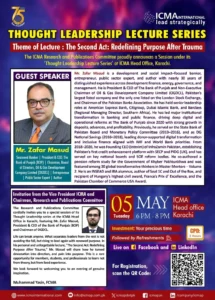
The journey of leadership is often framed through the lens of professional achievements and corporate milestones, yet for Zafar Masud, it is inextricably linked to a profound moment of survival. During a recent session at ICMA Karachi, the President and CEO of the Bank of Punjab shared a narrative that transcends the standard boundaries of banking and finance. His story is one of extraordinary resilience, starting with a career that spans over three decades across development finance, energy, and public policy.
Mr. Masud is not merely a banker but a thought leader whose life was fundamentally reshaped by a catastrophic event. As the survivor of a major plane crash, he describes that moment as a strategic inflection point that forced a complete re-evaluation of his life’s purpose. This experience served as the catalyst for his international best-selling book, which explores the concepts of hope and renewal in the face of absolute uncertainty.
The lecture highlighted how true power is not found in titles or balance sheets but in the clarity of one’s responsibility toward others. Mr. Masud emphasized that his current leadership style is a direct result of the insights gained during his recovery. He believes that the most difficult part of leadership is not the acquisition of knowledge but the consistent application of that knowledge into meaningful action.
The transition from a high-stakes corporate environment to a state of total vulnerability allowed him to see the financial sector through a different lens. He spoke about his roles at the Bank of Punjab and as the Non-Executive Chairman of OGDCL, noting that the scale of these institutions requires a leader who understands the weight of public trust. His survival gave him a unique perspective on managing large-scale operations with a sense of urgent stewardship.
A significant portion of his reflection was dedicated to his deep-rooted literary and intellectual heritage. Coming from a family known for its contributions to literature and philosophy, including figures like John Elia and Syed Mohammad Taqi, Mr. Masud feels a natural inclination toward storytelling. He noted that he is the third generation in his family to author books, suggesting that the drive to document experiences is part of his genetic makeup.
Writing “Out of the Box” was more than a professional endeavor; it was a necessary process of catharsis and documentation. He shared that while writing comes naturally to him, the act of speaking about the crash remains an emotionally taxing experience. Every time he recounts the events of that day, he is forced to manage a surge of memories that he would often prefer to leave in the past.
The emotional toll of being a public figure who survived such a tragedy is often overlooked by the audience. Mr. Masud was candid about the mental health challenges that follow surviving a trauma of that magnitude. He mentioned the months of therapy required to process the event and the ongoing need for mental health support even after the successful publication of his book.
He humorously remarked on the lighter side of his therapeutic journey while maintaining a serious tone about the necessity of psychological care. By sharing these personal details, he aims to destigmatize mental health discussions within the professional community. He views his survival not as a coincidence but as a divine opportunity to speak on these critical, yet often ignored, aspects of the human experience.
The audience at ICMA Karachi was given a rare glimpse into the psyche of a man who balances the rigors of Pakistan’s banking sector with the sensitivity of an author. He discussed the importance of corporate governance and how a resilient mindset can protect institutions during economic volatility. His leadership at the Pakistan Banks Association is informed by this dual understanding of technical expertise and human endurance.
Throughout the talk, the recurring theme was the idea of “Seat 1C” a reference to his location on the ill-fated flight and a symbol of his survival. He uses this symbol to remind others that every day is a gift that must be used for the betterment of society. His foundation and philanthropic work are extensions of this belief, focusing on providing support to those who face their own metaphorical crashes.
The lecture concluded with a call to action for the professionals in attendance to look beyond their immediate tasks and consider their broader impact. Mr. Masud’s life serves as a testament to the idea that professional success is hollow without a foundation of personal integrity and resilience. He encouraged the students and members of ICMA to embrace challenges as opportunities for growth and to never lose sight of their humanity.
As he wrapped up his address, the atmosphere in the hall was one of profound respect for a leader who has faced the ultimate test and emerged with a message of hope. His story continues to resonate across Pakistan’s professional landscape, offering a roadmap for how to lead with both strength and empathy. Zafar Masud remains a pivotal figure in the country, bridging the gap between corporate excellence and personal depth.