
The article “Documented houses, undocumented borrowers”, authored by Zafar Masud was published in on September 28, 2026 —
Documented Housing Solutions — Overview
The article weaves together critical themes surrounding Pakistan’s evolving mortgage market, emphasizing the significant role played by government interventions and the unique structural challenges faced. Published by Profit, a platform recognized for its analytical approach to economic and financial matters, the piece aims to inform readers about the importance of accessible housing finance and its broader societal effects. The tone is analytical yet hopeful, recognizing the strides taken while illustrating the ongoing challenges and the journey ahead. Zafar Masud’s inclusion is pivotal, lending authority as he discusses the transformative potential of these programs, reflecting his expertise as the president and CEO of the Bank of Punjab. His insights reveal not just the momentum gained but also the vision for scalability in housing finance in Pakistan, which serves as a case study for addressing similar barriers in other sectors while fostering sustainable development.
Article Summary
The article discusses the transformative shift in Pakistan’s mortgage market, particularly following the government’s initiatives in Punjab to support homeownership through the Apni Chhat Apna Ghar (ACAG) program. This program, recognized by UN-Habitat, effectively increases access to mortgages, addressing historical documentation challenges that have impeded financing for many potential homeowners. The APAC program’s successful implementation led to the disbursement of significant funds and loans, spotlighting the shift from viewing borrowers merely as risks to recognizing them as creditworthy. The broader implications extend beyond finance, highlighting the societal benefits of homeownership, such as improved mental health and social cohesion.
Documented houses, undocumented borrowers — Article by Zafar Masud
By Zafar Masud. published in on September 28, 2026
Documented houses, undocumented borrowers
CM Punjab’s Low-Income Housing Scheme — Selected for the 2026 Scroll of Honour, the UN’s highest recognition in the human-settlements field

For most of Pakistan’s independent history, its mortgage market has been a curiosity — an entire asset class that existed on paper but barely moved in practice.
Homes were built, bought and sold by the million; banks financed almost none of them. Mortgage-to-GDP hovered near one percent for two decades, roughly a tenth of India’s and a thirtieth of Malaysia’s.
The paradox was ours to solve: the country’s most documented asset was owned, overwhelmingly, by borrowers no bank could see on paper. A mortgage, for such a family, is not a financial product; it is the difference between paying rent forever and owning the roof.
Two years ago, something began to shift — not in policy pronouncements or balance sheets, but in the plumbing between them. This is the story of what happened next, and of why the market had stayed frozen for so long. A mortgage in Pakistan is a decision that touches a dozen registries — identity, income, land title, transfer history, building approvals, utility connections — each sitting in a different silo, on a different form, in a different hand.
A prospective borrower might have a title, a job and a family, but almost none of it visible to a bank as an underwriteable file.
Foreclosure remedies remained slow; long-tenor money to fund twenty-year assets was scarce; supply-side finance for affordable construction was episodic. Each obstacle was, on its own, an honest reason for a bank to hesitate. Together, they had produced a market everyone talked about but no one financed.
The change began in Punjab. Rather than layering another subsidy onto a system that could not read borrowers, the Government of Punjab set out to rewire the plumbing itself. Provincial agencies — PHATA, the Urban Unit, PITB, PLRA — pooled land records, planning data and the technology backbone. Microfinance partners — Akhuwat, NRSP, RCDP — carried last-mile origination and the trust of first-time borrowers. The Bank of Punjab managed the entire programme with all the stakeholders, and carried the balance sheet: as blended contingent risk in Phase I, and since April 2026 as the direct funding vehicle, in addition to blended risk, in Phase II, delivering the full journey digitally with the Urban Unit and MFIs as service providers.
Each step of a mortgage journey was assigned to whichever institution could best perform it and stitched into a single workflow. This is Apni Chhat Apna Ghar (ACAG) — 200,000 loans and Rs 260 billion disbursed to date, and perhaps the world’s largest, fully digital, interest-free, low-cost housing mortgage scheme.
On 14 September 2026, UN-Habitat selected PHATA, through the ACAG Program, to receive the 2026 Scroll of Honour — the highest honour UN-Habitat confers, and a first for Pakistan. ACAG was for first-time homeowners; for those needing a repaired roof, an extra room, a kitchen rather than a new home, the same architecture produced a second instrument. Apni Chhat, Mehfooz Chhat (ACMC) is a home-improvement mortgage: two tiers up to Rs 500,000 and Rs 1 million respectively, released against MFI verification of borrower creditworthiness and funding purpose. As in ACAG’s Phase II, both the funding and the blended contingent risk in ACMC have been assumed by The Bank of Punjab.
Together, ACAG and ACMC form a two-tier interest-free mortgage stack that reaches households a conventional mortgage never could.
The choice of instrument was deliberate, and it is where the plumbing and the people meet: documentation is what makes dignity bankable. A grant, or social housing, would have been simpler and in the short run cheaper. Both have their place, but a narrow one: the cases where the opportunity to work does not exist — disability, old age, circumstances of a similar nature, and at times cultural and social norms that, while never an excuse not to work, are genuine constraints nonetheless. Those households deserve security and respect no less, and for them grants and social housing can sensibly run in tandem with the mortgage programmes. For the majority, and on most measures that matter, the mortgage wins. It treats the household as a creditworthy citizen rather than a recipient of charity, and asks something back — a repayment that builds a credit history, an identity on file, and a stake in staying employed. Every rupee repaid funds the next family; with recoveries above 99 percent, the Rs 260 billion disbursed is a revolving pool, not a sunk cost. The dignity is in the obligation. A grant would have housed these families; the mortgage made them visible.
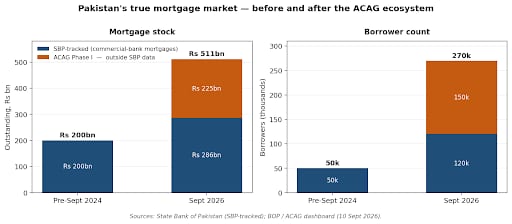
The effect shows in the national data. Formal mortgages tracked by the State Bank hit an all-time high of Rs 286 billion in July 2026 — against a stock that had never crossed Rs 200 billion or 50,000 borrowers before September 2024. Add ACAG’s Phase I loans held on microfinance books outside SBP data (around 134,000 loans and Rs 200 billion to March 2026), and Pakistan’s true mortgage market now stands at roughly Rs 511 billion and 270,000 borrowers — 2.5 times the amount, and 4.5 times the borrowers, of anything the country had previously assembled.
At the federal level, a companion has arrived. The Prime Minister’s Apna Ghar Programme, launched on 29 April 2026, extends the ecosystem nationwide with a broader ticket size, across every province, Azad Kashmir and Gilgit-Baltistan. Traction is visible directly in SBP data: the roughly Rs 110 billion and 56,000 mortgages added to the tracked market since April are largely attributable to ACAG Phase II together with the PM’s scheme.
| ACMC (mortgage) | ACAG (mortgage) | PM’s Apna Ghar (mortgage) | |
| Purpose | Home improvement — roof, room, kitchen | New home, first-time buyers, Punjab | New home, first-time buyers, nationwide |
| Ticket | Up to Rs 1m (two tiers) | Up to Rs 1.5m per household | Up to Rs 10m (four tiers) |
| Rate / cost | Interest-free to household, tranche-based | Interest-free to household | Subsidised markup, 20-year tenor |
| Eligibility | Punjab resident | Punjab resident, first-time buyer | Resident across the country, GB and AJK, first-time buyer, income ≥ Rs 40k/month |
| Delivery | BOP + PITB + AIM + Urban Unit + PHATA | Phase I: MFIs + BOP + UU + PHATA + PITB; Phase II: BOP direct, digital | All commercial, Islamic and microfinance banks + HBFCL |
| Status / scale | Part of Punjab stack’s 500k target by Jun 2028 | 200,000+ loans / Rs 260bn; ACAG+ACMC target 500k by Jun 2028 | 500,000 homes target over 5 years; Rs 3.2tn |
The Punjab housing stack (ACMC + ACAG) alongside the federal extension.
Set against our regional peers, the scale of what has been achieved — and the distance still to travel — becomes clearer. Even Bangladesh sits at around 3 percent of GDP on the mortgage measure; India has moved to roughly 12; Thailand to around 20; Malaysia to about 45; developed markets above 50.
ACAG, ACMC and the PM’s scheme have essentially doubled Pakistan’s ratio in under two years — from about 1 percent of GDP to close to 2 — but it still sits below Bangladesh’s and at less than a sixth of India’s.
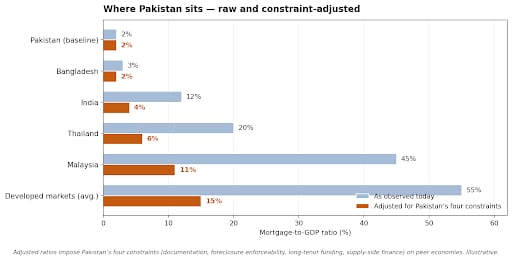
Adjust the comparison for what actually explains the peer numbers, and the story shifts. India’s ratio is not Indians wanting mortgages more than Pakistanis; it is Aadhaar making borrowers legible, the Real Estate Regulatory Authority (RERA) formalising supply, National Housing Bank refinance providing long-tenor liquidity, and firmer foreclosure remedies. Malaysia’s 45 percent is what happens when all four constraints have been addressed for decades. Impose Pakistan’s four constraints on our peers, and India’s ratio collapses toward 4 percent, Thailand’s toward 6, Malaysia’s toward 11, and even developed markets to around 15. Our 2 percent is not a demand problem or a bank-appetite problem; it is the arithmetic of four narrow pipes.
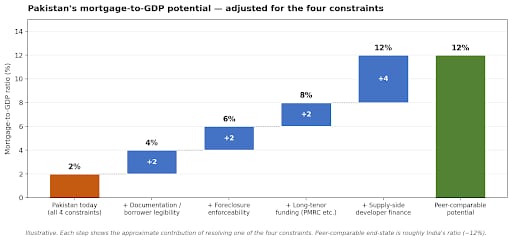
The waterfall makes the same point from Pakistan’s side, resolved upward: documentation first; then foreclosure reform, recently enacted; then long-tenor funding through pension and insurance flows; and, largest of all, the supply side, because without affordable units to buy, mortgage demand simply inflates the existing stock. Together the four take Pakistan to where its peers already are.
The lesson is not confined to housing: the same pattern shows in agriculture predominately through the CM Punjab Kissan & Livestock Cards, and in SME financing doubling on the back of SBP’s targeting framework, while private-sector credit overall has grown above 15 percent — healthy, but nothing like the multiples seen where an ecosystem has been purpose-built.
The three programmes prove the operating model; they do not substitute for structural reform. Three things would multiply what has been built: cash-flow underwriting, so the self-employed are assessed on what they earn, using data — Raast, 1Link, utilities, land records — that already exists and needs stitching through a Financial Data Exchange (FDX); a Pakistan Mortgage Refinance Company (PMRC) robust enough to refinance this new paper and free bank balance sheets for the next cohort; and, most critical of all, the supply side.
Housing finance in Pakistan has been described, for as long as I can remember, as the market that cannot scale. The evidence of the last two years — three programmes on the same purpose-built rails — is that it can. The Punjab stack is on course for 500,000 borrowers by June 2028, and the PM’s scheme for another 500,000 nationally. The proof of concept is in. The proof of scale is what comes next.
No discussion is complete merely on financial or economic terms alone, so let’s turn, finally, to the social and psychological case — because housing, and the mortgaged home in particular, is not merely a rooftop. On terms as favourable as those of ACAG and the Prime Minister’s programme — interest-free in the one, markup-subsidised in the other — a mortgage is the most disciplined saving instrument most families will ever hold: the monthly sum that once vanished as rent now accumulates as equity, an asset the children inherit, and in time the first collateral for a small business. And the security of a home that is owned rather than rented brings dividends that are among the best-documented findings in social science, whichever programme granted the title. Owners report lower chronic stress and better mental and physical health. Their children stay in school longer and are likelier to become owners themselves. Stable ownership tracks with lower crime and stronger social cohesion. For women, a home in the family’s own name is a security against widowhood and separation that a tenancy never provides; for the old, where pensions reach so few, a house owned outright is the retirement plan. None of these is a side-effect of a housing programme; they are the foundations of a productive and healthy society.
All of this runs through the banks, and their role deserves to be named. Long accused of financing only the sovereign and a few hundred corporates, the same banks, once a government set about building the ecosystem alongside them, have lent where they were told they never would and put households on the balance sheet as owners rather than tenants. That commitment from government — federal and provincial alike — is the precondition, and it is needed not only for affordable housing but for every priority sector in our beloved country. Punjab is clearly ahead of the pack and continues to build on that lead.
Authored by Zafar Masud. Originally published in on September 28, 2026