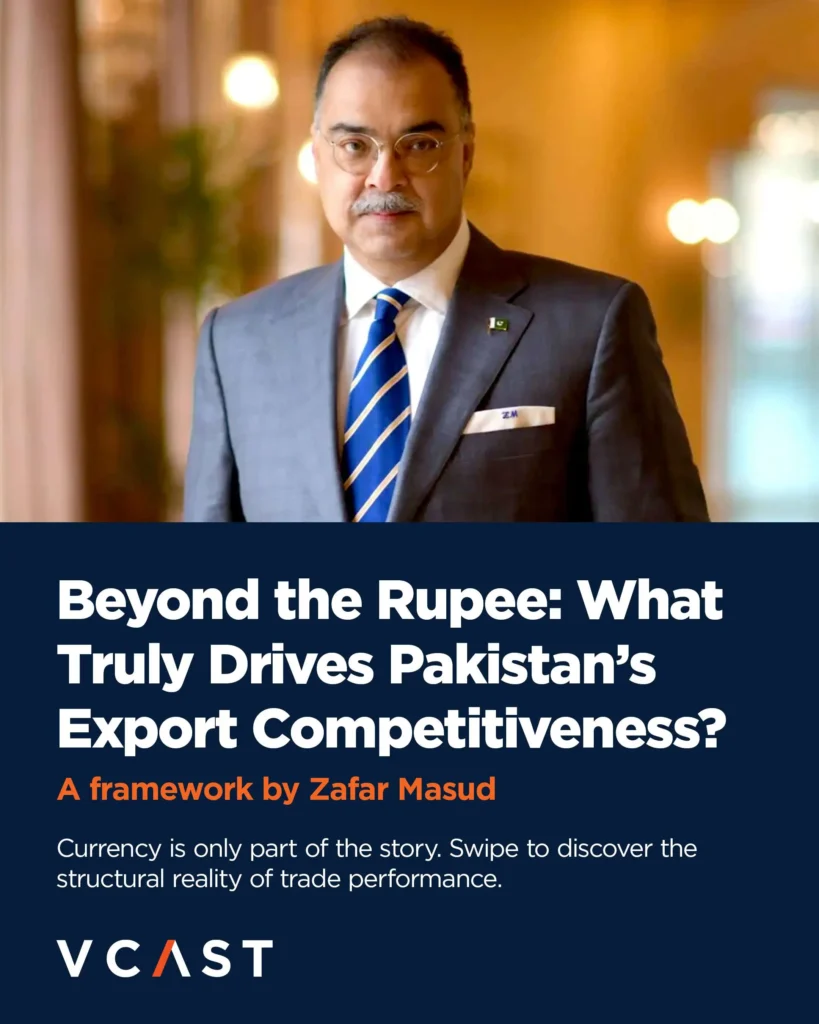
The article “Cheap currency, costly illusion”, authored by Zafar Masud was published in on July 1, 2026 — Our export problem has never really been about the price of the rupee. It is about the price of electricity, the speed of a refund, the diversity of a product line and the predictability of a policy… Treated as the whole answer, the currency becomes the path of least resistance, letting policymakers defer the hard structural fixes year after year. It is a necessary step but hardly the complete solution.
Cheap currency, costly illusion — Overview
This article was published by Dawn, a prominent Pakistani news outlet, on July 1st, 2026. The article discusses misconceptions surrounding the role of currency devaluation in enhancing export competitiveness in Pakistan. The tone is analytical and critical, aiming to reshape popular narratives by presenting evidence against the simplistic view of currency value as the primary lever affecting export performance.
Zafar Masud’s role as the author is significant because he provides expert insight as a senior banker, advocating for deeper structural reforms rather than just focusing on the currency issue, thus reflecting his professional background. The significance of including Masud lies in his authority, lending credibility to the arguments presented while driving the narrative towards a more nuanced understanding of the economic landscape. The broader narrative calls for comprehensive economic reforms to address long-standing issues and relies on evidence from international examples to reinforce his points.
Article Summary
In “Cheap currency, costly illusion,” Zafar Masud explores the fallacy that exporting competitiveness hinges solely on the rupee’s value. He argues that while the currency’s fluctuations do impact exports, the main issues lie deeper within the economic structure, such as energy prices and import dependencies. Masud emphasizes that merely devaluing currency is an inadequate solution; effective reforms in energy tariffs, trade facilitation, and overall productivity are quintessential for improving export performance. He urges for a holistic approach to address these structural challenges, advocating that currency adjustments should be one of many components in a comprehensive economic strategy.
Cheap currency, costly illusion — Article by Zafar Masud

By Zafar Masud. published in on July 1, 2026
THERE is a comforting story we tell ourselves about exports — that the rupee is the lever, and the zealots suggest that if only it were allowed to fall far enough, our factories would roar back to a state of competitiveness. It is a tidy theory, and an attractive one, because it locates the problem outside ourselves. It is also wrong, or at least dangerously incomplete. It is one valve in a larger system. And a country that keeps reaching for it while the pipes corrode elsewhere will find that the water never quite arrives.
The evidence is unsentimental. Research by the State Bank puts the responsiveness of our exports to the exchange rate well below one — a one per cent appreciation in the nominal effective rate trims export demand by only about 0.56pc. But the more decisive number is the import content of what we sell.
Roughly 37pc of our export value is itself imported: about 24pc in raw materials such as yarn, fibre and PTA (purified perephthalic acid), and 16pc in capital goods. Textiles, around 55pc to 60pc of what we sell abroad, are the most import-hungry of all. So when the rupee falls, the cost of the very inputs that exporters depend on rises almost in lockstep, and the price advantage we thought we had bought, is quietly clawed back at the customs counter — while the buyer abroad also demands his own pound of flesh from it.
This is why currency, in any honest weighting, deserves perhaps an eighth of the explanation, and not the lion’s share. The heavier weights belong elsewhere. Energy is the binding constraint: our industrial tariffs of roughly 13.5 cents to 15 cents per unit tower over India’s 12.1, Bangladesh’s 8.7, Vietnam’s 7.5 and Malaysia’s four cents. For a textile mill, that gap is the difference between winning an order and losing it to Dhaka. Then come the other levers: productivity and the climb up the product ladder; trade facilitation, where every day shaved off a customs delay lifts trade by roughly 1pc; a tariff structure that does not tax exporters through cascading duties on inputs; and diversification.
Fix the structural levers, and the currency becomes a supporting instrument.
Take a look at the peers we measure ourselves against. Vietnam took merchandise exports from under $50 billion in 2007 to more than $370bn by 2024 — not by chasing a cheaper currency but by holding competitive energy prices, securing duty-free access to inputs, signing trade agreements and moving into electronics, machinery and footwear. South Korea multiplied its exports more than twentyfold over four decades through technology and skills. The countries that devalued repeatedly without fixing anything underneath — Argentina being the standing monument in this regard — transformed nothing.
We have a fresher cautionary tale. Between 2021 and 2023, Türkiye let the lira fall around 60pc against the dollar. Inflation roared from about 19pc to above 85pc, yet exports grew only around 13pc, while imports rose by a third and the deficit ballooned to roughly 9.5pc of GDP.
Devaluation alone is not merely insufficient; it is also expensive. The bill arrives in the form of inflation, a heavier dollar-debt burden, eroded real wages for a population that is a net food-and-energy importer, and the flight of the confidence the tradable sector requires.
None of this means the rupee should be defended at any price. Where a currency is genuinely overvalued, refusing to adjust simply taxes exporters indefinitely. And our recent record on this count is a sobering one: between May 2023 and December 2025, despite nominal rupee weakness, the real effective exchange rate appreciated by about 19pc as domestic inflation overwhelmed the nominal move — and against China, our largest trading partner, real appreciation topped 20pc. That clearly points to an erosion of competitiveness.
But two cautions matter. The observed REER (real effective exchange rate) is a relative-price index, not a misalignment gauge; sizing true over- or under- valuation requires an equilibrium-REER estimate, not the headline number. And remittances cut both ways. As a large, durable, non-debt inflow, they raise the sustainable equilibrium rate, which means that we are less overvalued than a trade-only view would suggest. Yet the same inflows bid up non-tradable prices and prop up the rupee, flattering the index while the tradable sector quietly weakens. This is full-blown Dutch disease, and its lesson is blunt: you cannot devalue your way out of a remittance-driven appreciation, because the inflow simply re-appreciates the currency.
So the resolution is neither denial nor devaluation-as-panacea. It is sequence. If diagnosis confirms the rupee is overvalued, exchange-rate adjustment belongs in the package — but only alongside energy reform, productivity, trade facilitation, fiscal discipline and diversification, and never as a substitute for them. Treated as the whole answer, the currency becomes the path of least resistance, letting policymakers defer the hard structural fixes year after year. It is a necessary step but hardly the complete solution.
Our export problem has never really been about the price of the rupee. It is about the price of electricity, the speed of a refund, the diversity of a product line and the predictability of a policy. Worse, the public investment those levers depend on has been thinning in real per-capita terms precisely when exporters face mounting exchange-rate pressure. Fix the structural levers, and the currency becomes a supporting instrument. Reach for it alone, and we keep running faster only to stand in the same place.
Read more: Default and Restructuring
The writer is a senior banker.
Published in Dawn, July 1st, 2026
Authored by Zafar Masud. Originally published in on July 1, 2026
See Also
This Export Competitiveness Framework by Zafar Masud, presented by VCAST, bypasses short-term monetary fixes to analyze the genuine structural drivers of Pakistan’s trade potential. By exploring critical pillars—such as reducing uncompetitive industrial energy tariffs, mitigating high import dependencies on raw inputs, enhancing domestic value addition, and establishing long-term policy predictability—this framework offers a strategic blueprint for sustainable, resilient economic growth.