
Summary
In the conclusion of his previous article Digital Currencies in Pakistan, BR OPINION, Part 1 for Business Recorder, Mr. Zafar Masud outlines a strategic path for adopting digital currencies in Pakistan.He asserts that this transition is no longer a “good to have” luxury but a survival necessity for a nation where 70% of the population is under 23.
Gist: A Dual-Track Necessity for Survival The article highlights the Central Bank Digital Currency (CBDC) project as it moves through the SBP 5P methodology, aiming to reduce the informal economy and enable offline payments. Mr. Masud advocates for adopting digital currencies in Pakistan by integrating cross-border stable-coin settlements and tokenized deposits into the existing banking infrastructure. By focusing on financial inclusion through digital assets, Pakistan can bridge the gap for its unbanked citizens while navigating the delicate balance of geopolitical influence and market volatility.
This is part two of the analysis. For more details, refer to the full series on digital evolution.
- Part 1: Digital Currencies in Pakistan — Compelling Constructive Article in BR OPINION, Part 1
- Part 2 (this article): Adopting Digital Currencies in Pakistan — Survival for a Sustainable Future — BR OPINION, Part 2
E-Paper Cuttings
Source Links
- Text Article: https://epaper.brecorder.com/2026/01/29/6-page/1086456-news.html
- E-Paper Page 6: https://epaper.brecorder.com/2026/01/29/6-page.html
- E-Paper Page 7: https://epaper.brecorder.com/2026/01/29/7-page.html
The age of digital currencies—II
A Proactive Framework for Adopting Digital Currencies in Pakistan
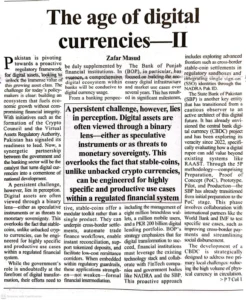
Pakistan is pivoting towards a proactive regulatory framework for digital assets, looking to unlock the immense value of this growing asset class. The challenge for today’s policymakers is clear: building an ecosystem that fuels economic growth without compromising financial integrity.
With initiatives such as the formation of the Crypto Council and the Virtual Assets Regulatory Authority, Pakistan has signaled its readiness to lead. Now, a synergetic partnership between the government and the banking sector will be the catalyst that turns digital currencies into a cornerstone of national development.
A persistent challenge, however, lies in perception. Digital assets are often viewed through a binary lens—either as speculative instruments or as threats to monetary sovereignty. This overlooks the fact that stable-coins, unlike unbacked crypto currencies, can be engineered for highly specific and productive use cases within a regulated financial system.
Supplementing Government Efforts with Tokenized Deposits
While the government’s role is undoubtedly at the forefront of digital transformation, their efforts need to be duly supplemented by financial institutions. In essence, a comprehensive digital ecosystem within banks will be conducive to digital currency usage.
From a banking perspective, stable-coins offer a modular toolkit rather than a single product. They can underpin cross-border settlements, automate trade finance workflows, enable instant reconciliation, support tokenized deposits, and facilitate low-cost remittance corridors. When embedded within regulatory guardrails, these applications strengthen—not weaken—formal financial intermediation.
The Bank of Punjab (BOP), in particular, has focused on building the necessary digital infrastructure and market use cases over several years. This has resulted in significant milestones, including the management of eight million branchless wallets, a million mobile users, and a PKR 200 billion digital lending portfolio. BOP’s strategy emphasizes that for digital transformation to succeed, financial institutions must leverage the existing technology stack and collaborate with FinTech companies and government bodies like NADRA and the SBP. This proactive approach includes exploring advanced frontiers such as cross-border stable-coin settlements in regulatory sandboxes and integrating single sign-on (SSO) identities through the NADRA Pak ID.
The SBP 5P Methodology and the Digital Rupee
The State Bank of Pakistan (SBP) is another key entity that has transitioned from a cautious observer to an active architect of this digital future. It has already envisioned the central bank digital currency (CBDC) project and has been exploring its veracity since 2022, specifically evaluating how a digital rupee can add value beyond existing systems like RAAST. Through the 5P methodology—comprising Preparation, Proof of Concept (PoC), Prototype, Pilot, and Production—the SBP has already transitioned from initial preparation to the PoC stage. This phase involves collaboration with international partners like the World Bank and IMF to test specific use cases, such as improving cross-border payments and streamlining social disbursement.
The development of a CBDC is strategically designed to address two primary local challenges: reducing the high volume of physical currency in circulation, which currently fuels the informal economy, and enabling offline payment capabilities to supplement the RAAST network when internet access is unavailable. Current exploration focuses on critical design choices, such as whether the system will be centralized or DLT (Distributed Ledger Technology) based, and its status as a remunerated or non-remunerated asset. Pakistan’s approach mirrors global trends—such as China’s need for private sector backups, Sweden’s response to declining cash, and the Bahamas’ efforts to reduce distribution costs—by seeking a more cost-effective and resilient financial infrastructure.
Facilitating Cross-border Stable-coin Settlements and US Investment
While the aforementioned benefits are evident, it is equally pertinent to assess risks associated with Pakistan’s embrace of digital assets, particularly in the context of its ties with the United States. It is first important to acknowledge, that proximity to the U.S presents a prime opportunity for companies in Pakistan to raise capital from US investors, as demonstrated by the startup ‘ZAR’, which recently raised USD 13 million. This provides a tailwind for Pakistani businesses, including those in sectors like critical metals, to attract US investment.
At the same time, it is important to draw attention towards potential concerns. For instance, the role of private entities like ZAR has been scrutinized; by explicitly stating that the Pakistani Rupee could be replaced by dollar stable-coins, these platforms are seen as potentially extending US financial control.
Market stability remains a secondary, yet equally pressing area of concern. With major crypto currencies such as Bitcoin dropping 25 percent from its recent peaks, significant capital is being lost by the Pakistani public, particularly through leveraged contracts on popular platforms like Binance. This level of financial disruption raises questions about how the government intends to manage these risks while appearing to support the sector.
Pakistan therefore faces a delicate balancing act: it must navigate the friction between fostering a globally competitive tech ecosystem and safeguarding its economic sovereignty from both external geopolitical influence and internal market volatility.
Strategic Recommendations for Financial Inclusion through Digital Assets
The Bank of Punjab hosted an experts’ panel during the 2025 SDPI Sustainable Development Conference, where the experts proposed a host of recommendations, which can be undertaken in the medium term to ensure a smooth adoption of digital currencies into the financial system.
Pakistan possesses a wealth of talent and natural resources that provide a strong foundation for a digital economic transformation. To harness this potential, the government must design robust onshore tokenization frameworks, while regulators work to translate these policies into seamless execution.
With this regulatory backing, financial institutions and banks can launch innovative services such as tokenized deposits and stablecoin-based remittances to improve efficiency. Furthermore, these advancements would enable modern trade finance transactions, stablecoin-collateralized lending, and secure custody services, ultimately positioning Pakistan as a competitive player in the global digital economy.
Furthermore, the existing Crypto Council must be restructured into a more inclusive and broad-based body that ensures diverse representation across the financial and tech sectors. To ensure these efforts meet global standards, Pakistan should actively leverage the technical assistance and expertise of international development partners such as the United Nations Development Programme (UNDP) and the Asian Development Bank (ADB).
The Imperative of Adopting Digital Currencies in Pakistan
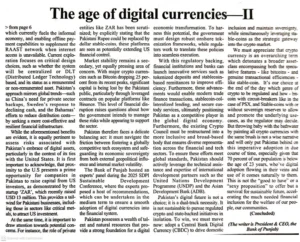
Pakistan’s digital future is not a choice; it is a dual-track necessity. It is not sustainable to pursue regulated crypto and state-backed initiatives in isolation. To win, we must move now: adopt a Central Bank Digital Currency (CBDC) to drive domestic inclusion and maintain sovereignty, while simultaneously leveraging stable-coins as the strategic gateway into the crypto market.
We must appreciate that crypto currency is an overarching term which detonates a broader asset-class encompassing both the speculative features – like bitcoins – and genuine transactional efficiencies – like stable-coin. It’s our choice at the end of the day which genre of crypto to be regulated and how – bitcoin with circuit-breakers like in the case of PSX, and Stable-coins with or without sovereign reserves to allow and promote the underlying use-cases, as the regulator may decide.
But throwing baby with the bathwater by painting all crypto currencies with the same brush is not a wise narrative and will only put Pakistan behind on this imperative adoption in due course of time, especially given that 70 percent of our population is below the age of 23 years, who’ve digital adoption flowing in their veins and use of it comes naturally to them. This is not the “good to have” or a “sexy proposition” to offer but a survival for sustainable future, accelerating the much needed financial inclusion for the welfare of our people, our communities.
Concluded