
Zafar Masud delivers a powerful and moving address to the graduating class, sharing timeless wisdom on resilience and the true meaning of success. What is the one defining principle that can turn every challenge into a stepping stone for greatness?
Greenwich University’s 17th Convocation in Karachi
This inspiring message was delivered at the 17th Convocation of Greenwich University, held at the Governor House in Karachi. The ceremony, themed “Fasal-e-Gul” to symbolize renewal and growth, was a landmark event for the institution as it celebrated the academic achievements of over 500 students. It was a particularly momentous occasion for Zafar Masud himself, as he was conferred with an honorary PhD (Honoris Causa) during the same ceremony, in recognition of his extraordinary contributions to the banking sector and his remarkable personal journey of resilience.
Zafar Masud’s Message to Graduates
In his address, Zafar Masud’s message to graduates emphasizes the importance of character, empathy, and purpose-driven leadership in the modern world. Drawing from his own life-altering experiences, he encourages the graduates to look beyond conventional metrics of success and instead focus on how they can contribute to the progress of Pakistan. He highlights that while academic excellence provides the foundation, it is one’s ability to remain steadfast in the face of adversity and to “reach back” to help others that truly defines a legacy. His message serves as a call to action for the youth to become ethical leaders who prioritize national service and human values above all else.
Embracing the Deep End: Zafar Masud’s Vision for the Next Generation of Leaders
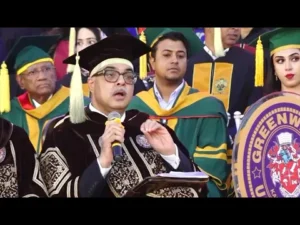
At the 17th Convocation of Greenwich University in Karachi, Zafar Masud, a prominent figure in Pakistan’s financial sector and a survivor of incredible adversity, delivered a poignant and empowering message to the graduating class of 2026. His address was not merely a congratulatory speech but a strategic roadmap for navigating the complexities of post-academic life, centered on resilience, community, and the transformative power of contribution.
This message was delivered at the same event in which Zafar Masud was conferred with an honorary Doctorate degree (PhD) by Greenwich University in recognition of his extraordinary contributions to the banking sector and his remarkable resilience as a survivor of the PK-8303 plane crash. The ceremony, served as a backdrop for Masud to share the profound wisdom he has gained through both professional success and personal trial. His words to the graduating class reflected a deep-seated commitment to mentorship, urging the new alumni to look beyond their academic achievements toward the responsibilities that come with their new status.
Transitioning from Structure to the “Deep End”
One of the most striking metaphors in Zafar Masud’s message to graduates is the transition from the “protected and structured environment” of academia to what he calls the “deep end” of the real world. For years, graduates have operated within the safety of syllabi, grades, and administrative support. Masud warns that this safety net is now gone.
By entering the professional and social world, these young adults are being “thrown in the deep end”, where the rules are less clear and the stakes are significantly higher. This shift requires a fundamental change in mindset—from being a recipient of guidance to becoming an architect of one’s own path.
Resilience in the Face of the Unexpected
Zafar Masud’s Message to Graduates is grounded in a realism that acknowledges the inevitability of hardship. He candidly tells the graduates that they will “suffer setbacks” and encounter “surprises in life”. However, his advice is to not let these moments define them as “end all or be all.”
Drawing inspiration from the poet Rumi, in Zafar Masud’s Message to Graduates, he notes that it is through these very cracks and setbacks that growth occurs, stating that “the wound is the place from where the light enters you”. He encourages the youth to take these challenges in stride, using them as catalysts for self-improvement rather than reasons for despair. In the unstructured “real life world,” the ability to learn from failure is perhaps the most valuable skill a graduate can possess.
The Importance of the “Personal Ecosystem”
As the external structures of the university fall away, Masud emphasizes that graduates must “develop their own protection”. This protection comes in the form of a personal “ecosystem”—a network of support, values, and relationships that provides stability during turbulent times.
Zafar Masud’s Message to Graduates urges the them to:
- Develop and nurture this ecosystem for themselves and for others.
- Recognize the core: At the center of this vital support system is the family.
- Practice gratitude: To cherish, appreciate, and always be thankful for the family members who have supported them thus far.
By building a robust ecosystem, graduates do not just survive; they create a foundation from which they can safely take risks and pursue their ambitions.
The Contribution Life Cycle: A New Definition of Purpose
Perhaps the most philosophical part of Zafar Masud’s message to graduates is his “contribution life cycle” theory. He posits that until graduation, others—parents, teachers, and mentors—have been the primary contributors to the lives of these students.
The convocation marks the turning point where the cycle must shift. Masud asserts that “life is contribution really”. The true purpose of a graduate’s journey is not just personal gain or professional titles, but the ability to contribute meaningfully to the lives of others.
Conclusion: A Call to Service and Strength
Zafar Masud’s message to graduates is a powerful reminder that while the “deep end” of life can be daunting, it is also the place where the greatest impact is made. By embracing setbacks as light-bearing opportunities, nurturing a strong family-centered ecosystem, and shifting their focus toward contribution, the Class of 2026 is well-equipped to lead Pakistan into a bright and resilient future.
Transcript of Zafar Masud’s Message to Graduates
You have all been operating within a very protected and structured environment so far. Now, you have been thrown into the deep end, and in this deep end, you will suffer setbacks and encounter surprises. Do not let these surprises weigh you down. Do not take these setbacks as the ‘end-all or be-all’ of your life.
Zafar Masud’s Message to Graduates at Greenwich University’s 17th Convocation
In fact, learn from them and improve yourself. As Rumi says, ‘The wound is the place where the light enters you.’ Take these setbacks in stride. In the real world—unlike your school or university—life is no longer protected or structured. You must develop your own protection by building an ecosystem.
Develop and nurture that ecosystem for yourself and for others. The starting point of this system is your family; they are right at the center of everything. Cherish them, appreciate them, and always be thankful for your family and your support network.
I have a theory I call the ‘Contribution Life Cycle.’ So far, people have been contributing to your life; now, it is your turn to contribute to the lives of others. Life is truly about contribution. That is my message to you all: that is what your purpose in life should be.
The 17th Convocation of Greenwich University
The Event: Fasal-e-Gul
The 17th Convocation of Greenwich University was not merely a formal distribution of degrees; it was a curated experience designed to uplift the national mood. Held on Saturday, January 17, 2026, the event transformed the sprawling lawns of the Governor House in Karachi into a vibrant tableau of academic pageantry. The theme, “Fasal-e-Gul”, was meticulously woven into every aspect of the ceremony, from the floral arrangements that adorned the stage to the optimistic tenor of the speeches. In a time when the national narrative often veers towards cynicism, Greenwich University chose to celebrate the “Season of Blossoms,” asserting that the youth of Pakistan represent a perennial spring capable of overcoming any winter of despair.
The Graduates and the Gold
The stars of the evening were the 501 graduating students who marched in the procession, their black gowns billowing in the Karachi breeze. The breakdown of the cohort reflected the university’s diverse academic portfolio: 362 undergraduates, 82 graduate students, and 57 postgraduates receiving their MPhil and PhD degrees. The air was thick with anticipation and pride as parents, many with tears in their eyes, watched their children ascend the stage—a physical manifestation of decades of hard work and sacrifice.
The highlight for the student body was the awarding of 25 Gold Medals. These medals were not just tokens of academic excellence but were sponsored by leading industries, symbolizing the strong link between Greenwich University and the corporate sector. The university’s philosophy of producing “market-ready” graduates was evident as these high achievers were recognized not just for their GPAs, but for their potential to lead in fields ranging from Business Administration to Media Studies and Social Sciences.
The Distinguished Guests
The convocation was graced by the presence of Sindh Governor Kamran Tessori, who served as the Chief Guest. In his address, Governor Tessori echoed the sentiments of Zafar Masud, emphasizing that the state looks towards these 500+ young minds as the engines of future progress. He commended Greenwich University for its consistency in maintaining high educational standards and for its role in projecting a soft, intellectual image of Pakistan globally.
The conferment of honorary degrees was a segment of particular prestige. Alongside Zafar Masud, the university honored three other titans of Pakistani industry and media:
- Senator Abdul Haseeb Khan: A pioneer in the pharmaceutical industry and owner of Brookes Pharma, recognized for his contributions to public health and industrial policy.
- Senator Sarmad Ali: The President of the All Pakistan Newspapers Society (APNS) and Managing Director of Jang & Geo Group, honored for his decades of service to journalism and media freedom.
- Jerjees Seja: The CEO of ARY Digital Network, celebrated for revolutionizing the Pakistani entertainment landscape and taking Pakistani content to a global audience.
These figures sat alongside the Chancellor, Dr. Seema Mughal, creating a tableau of leadership that spanned banking, media, industry, and academia.
Chancellor Seema Mughal’s Address
Dr. Seema Mughal, the matriarch of Greenwich University, delivered a moving welcome address. With the poise of an educator who has overseen generations of students, she traced the university’s four-decade journey. She spoke of the university’s commitment to “evolution and adaptation,” noting that education in 2026 is vastly different from what it was in 1987. She highlighted the university’s extensive work in sustainable development, aligning the institution with the United Nations Sustainable Development Goals (SDGs).
Her most touching remarks, however, were directed at the parents. “Behind every graduate standing here,” she said, “there are years of patience, sacrifice, prayers, and unconditional support.” She invited the students to rise and applaud their parents, a moment that dissolved the formality of the event into a shared emotional experience.
A Cultural Finale
True to the theme of Fasal-e-Gul, the evening did not end with the recession of the academic procession. The university organized a Qawwali night to conclude the festivities. As the soulful rhythms echoed through the Governor House, it provided a moment of catharsis and celebration. It was a reminder that education is not just about the rigor of the mind but also the enrichment of the soul. The graduates left the venue not just with degrees in hand, but with a memory of a night that celebrated their past achievements and blessed their future endeavors.
About Greenwich University
Genesis and History
To understand the significance of the 17th Convocation, one must understand the institution that hosted it. Greenwich University is not a newcomer to Pakistan’s educational landscape; it is one of the pioneers of private sector higher education in the country. Its roots go back to 1987 with the establishment of the Greenwich Institute. At a time when private universities were a rarity and the state sector was overburdened, Greenwich emerged as a beacon of quality business education.
Founded with a vision to bridge the gap between academic theory and corporate reality, the institute quickly gained a reputation for excellence. This relentless pursuit of quality culminated in 1998, when it was granted a charter by the Government of Sindh, officially becoming Greenwich University. This transition from an institute to a degree-awarding university marked a coming of age, allowing it to expand its faculties and research capabilities.
A Global Pioneer
Greenwich University holds a unique distinction in the history of Pakistani education: it was the first Pakistani university to establish a fully-fledged branch campus abroad. The establishment of Greenwich University Mauritius was a bold strategic move that signaled the institution’s confidence in its educational model. It was no longer just importing knowledge from the West; it was exporting Pakistani educational standards to the world.
This global outlook is further reinforced by its impressive array of accreditations and memberships. Greenwich is associated with the IAU (International Association of Universities). These linkages ensure that a degree from Greenwich is not just a local qualification but a globally recognized credential, facilitating student mobility and credit transfers to universities in the UK, China, and Malaysia.
Faculties and Academic Ethos
While it began as a business school, Greenwich has evolved into a comprehensive university with diverse faculties.
- Faculty of Management Sciences: The flagship faculty, known for producing CEOs, bankers, and entrepreneurs. The curriculum is rigorous, with a heavy emphasis on case studies, experiential learning, and industry integration.
- Faculty of Social Sciences: This faculty has grown significantly, offering degrees in Media, Mass Communication, and International Relations. It is designed to produce the thinkers, writers, and diplomats of tomorrow.
- School of Fashion: A more recent addition, this school acknowledges the booming textile and fashion industry of Pakistan, blending creativity with the business acumen required to run successful fashion brands.
The university’s ethos is summarized in its mission to create “Job Creators, not Job Seekers.” The pedagogy is heavily slanted towards entrepreneurship. Students are encouraged to develop business plans, launch startups, and think critically about solving local economic problems. This is supported by the Office of Research, Innovation, and Commercialization (ORIC), which fosters a culture of inquiry and practical research.
The Campus and Community
Located in the serene and upscale Defence Housing Authority (DHA) in Karachi, overlooking the Arabian Sea, the campus provides an environment conducive to learning. It is a purpose-built facility that blends modern infrastructure with spaces for social interaction. But the university extends far beyond its walls. Greenwich is deeply committed to Corporate Social Responsibility (CSR).
It was one of the first universities to integrate community service into its degree requirements. From adopting schools in underprivileged areas to running polio eradication campaigns and flood relief drives, the university instills a sense of civic duty in its students. The “Greenwich mechanism” of social work ensures that graduates leave with empathy for the marginalized, aligning perfectly with the message Zafar Masud delivered at the convocation.
The Alumni Network
Perhaps the greatest testament to Greenwich University’s success is its alumni. Over the last four decades, it has produced over 5,000 graduates who are now scattered across the globe. They can be found in the boardrooms of multinational corporations, in the corridors of power in Islamabad, and in the creative hubs of the media industry. The alumni network is a tight-knit community that actively supports the university, offering mentorship to current students and facilitating job placements.
Conclusion Greenwich University stands today not just as a place of learning, but as a national asset. Its 17th Convocation was a microcosm of its broader mission: to take the raw potential of Pakistani youth and refine it into the gold standard of leadership. As the graduates of the Class of 2026 step out into the world, inspired by the words of Zafar Masud and equipped with the education of Greenwich, they carry with them the promise of a “Fasal-e-Gul”—a season of blossoming that Pakistan so desperately awaits.