
On the final day of the the 17th Karachi Literature Festival, the most anticipated session was undoubtedly the Zafar Masud Seat 1C talk at KLF 2026. As the President of the Bank of Punjab and a PK8303 survivor, Masud shared profound insights that went far beyond a standard book launch.
Summary of the Seat 1C 51st Book Talk
The 17th Karachi Literature Festival reached a poignant peak on its final day during the 51st book talk dedicated to Zafar Masud’s transformative work, Seat 1C. The session opened with an exploration of the miracle of survival, framed not just as a personal story but as a universal exploration of hope and faith in a fragile world. Masud began by acknowledging the collaborative nature of the book, giving immense credit to his editors for crafting a flow and structure that makes the intense subject matter accessible. He highlighted a unique feature of the publication, the inclusion of sketch notes, which were specifically designed to re-engage younger generations with reading by providing visual entry points into each chapter.
As the narrative progressed, Masud shared the remarkable global journey of the book, which has already achieved international best-seller status with thousands of copies sold across multiple continents. He explained that his drive to write was rooted in a desire to leave a permanent creative legacy, a value deeply embedded in his family DNA as the nephew of the legendary poets and philosophers Jaun Elia and Rais Amrohvi. This heritage, combined with the singular experience of surviving the PK8303 crash, created what he described as a moral duty to report back from the edge of mortality. He sought to provide a structured account of his ten core learnings, moving beyond the tragedy to offer a roadmap for post-traumatic growth.
A central theme of the talk was the critical importance of communication, where Masud noted that a lack of clear dialogue between the cockpit and air traffic control played a devastating role in the actual accident. This led into the philosophical heart of the session: the concept of life before death. He challenged the audience to reconsider their priorities by focusing on the final thirty seconds of consciousness.
He described this brief window as a private court where an individual must act as their own judge and jury, emphasizing that the goal of a well-lived life is to reach that moment without regrets. He spoke candidly about channeling survivor’s guilt into a positive direction, urging that one must become a big enough human to forgive oneself and others.
Concluding the chronological summary of his talk, Masud read a final, moving passage from the book that encapsulated the essence of his journey. He discussed how the experience had fundamentally reshaped his approach to leadership, instilling a sense of fearlessness that now defines his professional and personal life. He warned that life is incredibly ephemeral and that the time to settle emotional debts and fix one’s path is now, rather than waiting for a moment when choice is no longer an option. The complete Q&A session is mentioned below separately.
Zafar Masud Seat 1C Talk at KLF 2026: Hope, Faith, and the Miracle of Survival
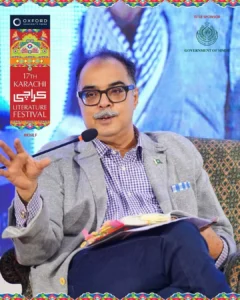
In the vibrant, wind-swept grounds of the Beach Luxury Hotel, the 17th Karachi Literature Festival (KLF) concluded its three-day celebration of the written word on February 8, 2026. While the festival hosted over 200 delegates and 90 sessions, one event stood out as a defining moment of emotional resonance and intellectual depth: the Zafar Masud Seat 1C talk at KLF 2026.
The session, which marked the 51st book talk for Masud’s memoir Seat 1C, drew a packed audience eager to hear from the Bank of Punjab CEO who had become a symbol of resilience. Masud, a PK8303 survivor, offered more than just a recounting of a tragedy; he presented a philosophical manifesto on the miracle of survival, the necessity of post-traumatic growth, and the urgent need to live a “life before death.”
The Atmosphere and the Legacy of the 51st Talk
As the sun began to set on the final day of the festival, the atmosphere inside the main marquee was charged with a unique blend of solemnity and anticipation. The Zafar Masud Seat 1C talk at KLF 2026 was not merely a book launch; it was a homecoming for a narrative that has traveled the globe. Masud began by noting the significance of this specific session. Having taken his book, Seat 1C, to audiences in the United States, the United Kingdom, Hong Kong, Macau, and Dubai, bringing the conversation back to Karachi—the city where the tragic crash occurred—held a special weight.
He described the session as the “51st talk,” a milestone that underscored the enduring relevance of his story. For a book to sustain such momentum a year after its release is rare, but Seat 1C has defied the typical shelf-life of a memoir. Masud attributed this not to his own celebrity as a banker but to the universal human questions the book addresses. The Zafar Masud Seat 1C talk at KLF 2026 served as a platform to explore these questions, moving beyond the sensationalism of the crash to the quiet, often difficult work of survival.
He acknowledged the presence of his close friends and family, noting that their support was integral to his journey, but quickly pivoted to the broader audience, inviting them into the intimate and terrifying 30-second window that changed his life forever.
See also: Seat 1C 50th Book Talk at HLF 2026 —11th Hyderabad Literature Festival
A Literary Heritage: The DNA of Authorship
One of the most compelling segments of the Zafar Masud Seat 1C talk at KLF 2026 was his reflection on why he chose to write a book in the first place. In a world dominated by digital media and fleeting attention spans, writing a physical book might seem like an antiquated choice for a high-profile corporate leader. However, Masud revealed that the impulse to write was, in his words, “in his DNA.”
As the nephew of the legendary poets and philosophers Jaun Elia and Rais Amrohvi, Masud hails from a lineage of intellectual giants. He shared with the audience that between his parents’ generation and the generation of his illustrious uncles, his family has produced nearly 50 books. The Zafar Masud Seat 1C talk at KLF 2026 highlighted this rich cultural heritage, suggesting that his transition from the Bank of Punjab CEO to a best-selling author was not a career pivot but a return to his roots.
He argued that a book offers a “permanent legacy” that other mediums cannot match. While he has given countless interviews and appeared in numerous videos, he views those as transitory. A book, he asserted during the Zafar Masud Seat 1C talk at KLF 2026, allows for a structured, deeply thought-out exploration of trauma that can sit on a shelf and guide future generations.
He expressed a desire for Seat 1C to be his contribution to the world of creativity—a legacy that would outlast his tenure in the banking sector. This desire for permanence is a key driver behind the Seat 1C book summary and its detailed narrative, ensuring that the lessons learned from the miracle of survival are not lost to time.
See also: Jashn-e-Jaun Elia 2026 | Zafar Masud’s Informative Economy Session on Day 2
Reporting from the Edge: The Duty of a Survivor
A central theme of the Zafar Masud Seat 1C talk at KLF 2026 was the concept of “duty.” Masud spoke passionately about the responsibility that comes with being a PK8303 survivor. He told the audience that surviving a catastrophe that claimed 97 lives is not a stroke of luck to be enjoyed in silence; it is a mandate to speak. He described his survival as an opportunity granted by the Divine to “report back” from the edge of death.
During the Zafar Masud Seat 1C talk at KLF 2026, he posed a rhetorical question to the crowd: How many people have looked death in the face, seen the end approaching, and then returned to tell the tale? The answer, of course, is very few. This rarity creates an obligation. Masud feels he must articulate the emotions, the regrets, and the clarity of those final moments so that others can learn from them without having to endure the trauma themselves. He framed the book and the talk not as a commercial endeavor—noting that all proceeds go to charity—but as a service to humanity.
This sense of duty was palpable throughout the Zafar Masud Seat 1C talk at KLF 2026. He recounted how difficult it is to relive the trauma repeatedly for these sessions. Every talk requires him to reconstruct the crash, the fire, and the pain. Yet, he continues to do so because he believes the message of life before death is too important to keep to himself. He views his survival as a test: God saved him to see if he would share the lessons or hoard the second chance for himself. By traveling from city to city, from the Karachi Literature Festival Day 3 to international venues, he is fulfilling that covenant.
The Philosophy of the “30 Seconds”
Perhaps the most profound philosophical contribution of the Zafar Masud Seat 1C talk at KLF 2026 was his deconstruction of the concept of time—specifically, the “30 seconds of life before death.” Masud argued that human beings spend an inordinate amount of time worrying about “life after death.” Religions, cultures, and societies are built around the concept of the afterlife, of accountability to God, and of the final judgment. However, Masud posits that there is a precursor to that judgment that is entirely ignored.
In the Zafar Masud Seat 1C talk at KLF 2026, he described the final 30 seconds before the crash not as a blur of panic, but as a moment of hyper-lucidity. In those seconds, he realized that before he stood in God’s court, he was standing in his own court. He was the accused, he was the judge, and he was the witness. He explained to the hushed audience that if you cannot forgive yourself in those final 30 seconds, you will enter the afterlife with a heavy soul.
The miracle of survival for Masud was not just that his body survived, but that his soul was at peace in those final moments. He shared a deeply personal dialogue he had with himself as the plane went down. He looked back at his life—his childhood in Lahore, his struggles, his successes as a banker—and he realized he had no regrets.
He told the audience at the Zafar Masud Seat 1C talk at KLF 2026 that he was able to say, “God, I am ready.” This, he emphasized, is the goal of life before death: to live with such integrity and purpose that when the inevitable end comes, whether in a crash or in old age, you can face yourself without shame.
The Theory of Goodness and Human Nature
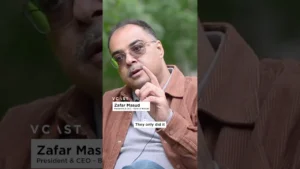
A significant portion of the Zafar Masud Seat 1C talk at KLF 2026 was dedicated to what Masud calls the “Theory of Goodness.” In an era often defined by cynicism and division, Masud’s experience offered a counter-narrative. He recounted the moments immediately following the crash. He was injured, his seat had been thrown clear of the wreckage, and he was surrounded by fire and devastation. In that hellscape, it was not government officials or organized rescue teams who reached him first—it was ordinary people.
During the Zafar Masud Seat 1C talk at KLF 2026, he described how strangers risked their own lives to pull him from the debris. They did not know he was the Bank of Punjab CEO. They did not know his name, his sect, his politics, or his bank balance. They only saw a fellow human being in pain. This act of selfless bravery forms the bedrock of his Theory of Goodness. He argued that human beings are inherently good and that if we view the world through a lens of suspicion, we create a suspicious world. But if we view it through the lens of the miracle of survival, we see that compassion is the default state of humanity.
He illustrated this with a powerful anecdote involving the National Savings protesters. Before the crash, as a senior executive, Masud had faced intense protests from a group of investors. They had chanted slogans against him and made his work life difficult. Yet, after the crash, those same people were among the first to visit him in the hospital, praying for his recovery. The Zafar Masud Seat 1C talk at KLF 2026 used this story to drive home the point that roles and titles are temporary, but the human connection is permanent. This reinforcement of the Theory of Goodness resonated deeply with the audience, offering a message of unity in a polarized society.
See also: Zafar Masud on the Goodness of People
Leadership, Fearlessness, and Mental Health
The transition from a survivor’s tale to a leadership masterclass was seamless in the Zafar Masud Seat 1C talk at KLF 2026. Masud spoke candidly about how the crash had altered his professional approach. He introduced the concept of “fearlessness” as a double-edged sword. Having survived death, the trivial fears of the corporate world—losing a deal, facing a difficult board meeting, making a controversial decision—evaporated.
He told the audience at the Karachi Literature Festival Day 3 that he is now “fearless” to a degree that he sometimes has to manage. He explained that a leader who fears nothing can sometimes take risks that those around him are not ready for. This evolution of the Bank of Punjab CEO into a fearless leader is a direct result of his post-traumatic growth. He realized that the worst-case scenario had already happened and he had survived it, so the stakes of the boardroom felt significantly lower.
However, the Zafar Masud Seat 1C talk at KLF 2026 also touched on a critical and often taboo subject: mental health in leadership. Masud broke the mold of the stoic Pakistani male executive by openly advocating for therapy. He argued that leaders in positions of power have a moral obligation to be mentally fit. If a CEO is carrying unresolved trauma or stress, their decision-making is compromised, and that compromise affects the livelihoods of thousands of employees.
He urged the corporate sector to destigmatize mental health support, citing his own journey of healing as proof that vulnerability is a strength, not a weakness. This segment of the talk was particularly impactful, as it came from a figure of immense authority in the financial sector.
See also: Mr. Zafar Masud’s Message on Mental Health May
Rituals vs. Spirituality: A Critical Distinction
In one of the most thought-provoking sections of the Zafar Masud Seat 1C talk at KLF 2026, Masud addressed the delicate balance between religious ritual and true spirituality. He reminded the audience that the crash of PK8303 occurred on the 27th of Ramadan, a Friday—one of the holiest days in the Islamic calendar.
He recounted that on that fateful day, there was a breakdown in communication and protocol. He suggested that sometimes, the obsession with ritual can overshadow the essence of humanity. He noted that while he is a person of deep faith—a faith that was solidified by his miracle of survival—he believes that God prioritizes human life and duty over performative rituals.
During the Zafar Masud Seat 1C talk at KLF 2026, he shared that while the plane was in trouble, the communication between the cockpit and the control tower was flawed, partly due to the casual atmosphere that can sometimes permeate during such times. He argued that true spirituality is about responsibility. It is about doing your job with excellence because people’s lives depend on it. He warned against using religion as an excuse for professional negligence. This nuanced take on faith and duty added a layer of social critique to the Seat 1C book summary, elevating it from a personal memoir to a commentary on societal values.
The Structure of the Book and Global Reach
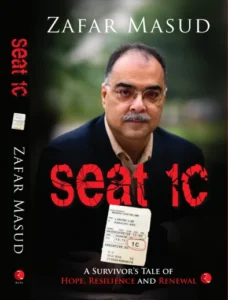
Masud also took time during the Zafar Masud Seat 1C talk at KLF 2026 to discuss the mechanics of the book itself. He explained that Seat 1C was designed to be accessible. Knowing that reading habits are declining, especially among the youth, he ensured the book was concise—around 210 pages—and could be read in a single weekend.
He highlighted the inclusion of “sketch notes,” a visual storytelling element designed to capture the attention of younger readers who might be intimidated by walls of text. This innovative approach has paid off. The book has sold over 6,000 copies in just 12 months, a staggering number for the region, with 2,000 of those sales coming from international markets. The Zafar Masud Seat 1C talk at KLF 2026 celebrated this success not as a commercial victory, but as a victory for the narrative of Pakistan. Masud expressed pride that a story from Pakistan was being read globally, shifting the narrative from terrorism and instability to resilience, literature, and post-traumatic growth.
He thanked his publishers, Oxford University Press, and his editors for their meticulous work. He admitted that the seamless flow of the book was due to their expertise, showing a humility that underpinned the entire session. The success of the book, discussed at length during the Zafar Masud Seat 1C talk at KLF 2026, proves that there is a hunger for authentic, hard-won wisdom.
Conclusion: The Legacy of Seat 1C
As the Zafar Masud Seat 1C talk at KLF 2026 drew to a close, the message was clear: life is fragile, and the time to act is now. Masud left the audience with a powerful call to action. He urged them not to wait for a tragedy to clarify their priorities. He implored them to fix their relationships, pursue their passions, and live their life before death with intensity and integrity.
The session was a testament to the power of storytelling. Zafar Masud, the PK8303 survivor and Bank of Punjab CEO, stood before the crowd not as a victim, but as a guide. His insights into the miracle of survival, his advocacy for mental health in leadership, and his unwavering belief in the Theory of Goodness made this talk the highlight of the festival. For those who attended the Karachi Literature Festival Day 3, the Zafar Masud Seat 1C talk at KLF 2026 was an unforgettable experience—a reminder that even in the face of death, the human spirit can find a way to soar.
Questions & Answers Session
Inherent Goodness and Humanity in Tragedy – Waleed
Waleed notes that there are two sides to the book: Masud’s personal experience and his observation of the rest of the world. He asks if the ultimate lesson is the “inherent goodness in people,” citing how strangers rescued him and how former protesters from National Savings came to visit him in the hospital. Is humanity’s true nature rooted in goodness?
Zafar Masud agrees completely, stating that his “Theory of Goodness” suggests that if you judge people through a lens of goodness, you spread goodness. He reflects on how the people who rescued him from the burning wreckage didn’t know who he was; they were simply saving a fellow human being. He emphasizes that being an impactful professional requires this element of humanity and goodness, otherwise, one is just another interchangeable CEO.
The Responsibility of Carrying a Message – Faraz
Faraz expresses that Masud’s message is “ultimate” and asks about the weight of carrying this message to others. How does it feel to be the vessel for such a profound lesson?
Masud responds that because God gave him this opportunity to return and tell his story, he views it as a mandatory duty. He feels a responsibility to explain what those final 30 seconds feel like so that others can fix their life priorities before they reach that same point.
Comparison of Near-Death Experience (NDE) Visuals – Faraz
Faraz asks about the specific visuals or sensations during the near-death experience, noting that different cultures and religions report various phenomena. Did Masud experience specific visuals or signs?
Masud explains that his experience aligns with much of the research on NDEs. He describes a “film” of his entire life playing in front of him, from his childhood in Lahore to his professional achievements. This visual review served as a spiritual self-assessment, allowing him to judge how he had lived his life in real-time as the crash was occurring.
Can a Married Banker Truly Be Fearless? – Aijaz
On a lighter note, Aijaz asks: Can a man who is both a banker and married truly be fearless?
Masud jokes that being a married banker is exactly what makes one fearless. He uses the humor to pivot back to the idea that fearlessness is a primary prerequisite for leadership in any facet of life, though he notes that since the crash, his fearlessness has become so intense that he sometimes has to consciously moderate it for the sake of those around him.
Managing Ego and Humility After a Miracle – Nasir
Nasir asks how a survivor manages the fine line between the potential arrogance of being “chosen” to survive and the humility that such an event should instill.
Masud explains that while the commercial world sometimes requires a “tough stance,” arrogance is a starting point for total destruction. He feels a deep sense of humility because the survival was not of his own doing. He believes that while you must be firm in your professional stance, you must remain deeply rooted in human empathy and humility to be respected in the long term.
The Conflict Between Religious Rituals and Duty – Anonymous
A question is raised regarding the “life system” and how belief works for those who might not follow a specific religion, and how rituals played into the tragedy.
Masud clarifies that while he is a person of total faith, he makes a distinction between rituals and true spirituality. He points out that on the day of the crash, some individuals were so focused on the ritual of Friday prayers that they neglected their immediate duty to ensure the safety of 100 lives. He argues that while rituals are important, they must not come at the cost of human responsibility and compassion.
The Internal Dialogue with God During the Crash – Khushbakht Zahra
Khushbakht Zahra asks about the specific feelings in the seconds when he realized he was surviving. What was that internal dialogue like?
Masud shares a deeply personal moment, recounting that during the crash, he spoke to God as if speaking to a friend, saying that his life had been good and he was ready if his time had come. When he realized he was being rescued, he describes a moment of almost “playful” internal dialogue where he felt he was told he was being given a second chance, leading him to even “complain” to his rescuers about his broken bones with a strange sense of calm because he knew he was meant to survive.
Normalizing Therapy and Mental Health for Leaders – Anonymous
The questioner asks about the importance of mental health and therapy in the aftermath of such trauma.
Masud emphasizes that mental health treatment must be stripped of its stigma. He argues that it is imperative for everyone, but especially for leaders in positions of power. If a leader is not mentally fit or is struggling with suppressed stress, their decision-making will inevitably suffer, which can negatively impact the lives of everyone they lead.
Compassion vs. Being a “People Pleaser” – Anonymous
How do you balance being a compassionate leader with the risk of becoming a “people pleaser”?
Masud makes a sharp distinction: people-pleasing is usually directed upward to superiors, while compassion is directed downward to those you lead. He shares that he has been fired from jobs in the past specifically because he refused to be a people-pleaser to his bosses. He believes that if you are a people-pleaser, your reputation becomes zero within minutes, but if you lead with genuine compassion and integrity, people eventually come around to respect your stance.