
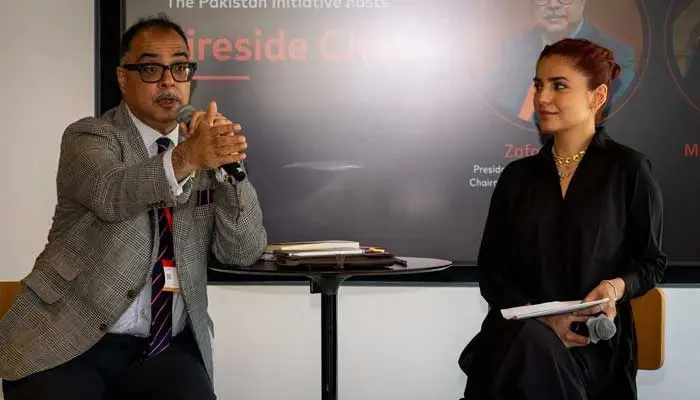
In this high-level fireside chat hosted by Mastercard, Zafar Masud (President & CEO of The Bank of Punjab) and Momina Mustehsan discuss women financial inclusion—the critical pathways to unlocking Pakistan’s economic potential. The conversation covers the financial inclusion gap, breaking cultural barriers for women in finance, leveraging stablecoins for remittances, and the role of digital infrastructure in empowering the youth demographic.
Women Financial Inclusion and Digital Banking in Pakistan
The transition toward robust Digital Banking in Pakistan represents one of the most critical economic opportunities of the decade. While the nation has achieved an impressive 98% digital identity onboarding rate, a significant gap remains, with only 30% of adults currently participating in the formal financial system. Bridging this divide requires a fundamental shift in institutional and societal mindsets, moving away from siloed data structures toward integrated, incentive-driven financial ecosystems.
During the recent Zafar Masud fireside chat, key structural barriers were analyzed, particularly regarding women financial inclusion, where currently only 18% of women hold active bank accounts. Overcoming these cultural glass ceilings is not merely a social imperative but an economic one, capable of adding billions to the national GDP. To accelerate Pakistan fintech growth, the discussion highlighted the necessity of embracing emerging technologies, including stablecoins and remittances optimization, which can reduce transaction costs to zero and seamlessly integrate the country’s massive freelance community into the global economy.
Harnessing the demographic dividend Pakistan possesses—with over 70% of the population under the age of 30—requires proactive state support and progressive policies. Institutions like The Bank of Punjab, in collaboration with the Mastercard Pakistan initiative, are already demonstrating the power of digital financial infrastructure through scalable programs like the Kissan Card and low-cost housing mortgages. Ultimately, as Zafar Masud reflects in his bestselling book, Seat 1C Zafar Masud, true leadership and resilience lie in driving systemic change that empowers every individual to contribute to a collective, prosperous future.
Related: Mr. Zafar Masud addressed the Women CEO Club on International Women’s Day