
Summary of Zafar Masud’s Keynote Speech at Justuju Rethink School Education with AI Conference
Zafar Masud opens by reflecting on his personal connection to Shahwilayat Public School, referring to it as “home.” He expresses gratitude to the trustees and organizers of the “Justuju” conference for creating a space to discuss the intersection of technology and the soul of education.
He frames Artificial Intelligence as a “meta-technology.” Unlike the internet or social media, which primarily act as distribution channels, AI is a generative force that interacts with human language and reasoning. It represents a fundamental shift in how we process knowledge.
Referencing the concept of Homo Deus, Masud notes that AI has transitioned from analyzing data to creating it. This ability to “create” mimics what was once considered a divine or strictly human power, necessitating a serious re-evaluation of how we manage its influence on young minds.
He discusses the irony of the modern classroom: students often possess more “horizontal” technical knowledge than their teachers. However, the teacher remains the guardian of “vertical” wisdom—the ethical, moral, and cognitive depth that technology cannot provide.
This is the core of the speech. Masud argues that if AI provides instant answers, it bypasses the “cognitive struggle” necessary for brain development. He insists that AI should be a collaborator (augmenting human effort) rather than a substitute (replacing human thought).
In a bold policy stance, Masud suggests that the government is too slow to regulate a field that evolves every week. Instead, he calls for a “Charter of Society”—a set of ethical norms and principles established by educators, parents, and the private sector to guide AI use.
Read more: We need a ‘Charter of Society’
He cites OECD data showing that countries that rushed to go 100% digital are now seeing a decline in student comprehension. He highlights a global trend of “re-analoging,” where schools are returning to paper and ink to help students retain focus and depth.
Drawing from his own literary background, Masud emphasizes that deep reading is the foundation of cognitive success. He argues that without the ability to engage with complex literature, students cannot develop the “thinking stamina” required for the AI era.
He proposes a scaffolded introduction to tech: minimal screen time for early childhood to protect brain development, supervised use in middle school, and advanced AI fluency (prompt engineering and ethics) in higher education.
The ideal classroom is hybrid. Teachers focus on the “Why” and the “How” (human judgment), while AI handles the “What” and the “When” through personalized, high-frequency practice at scale.
Masud warns that attention is now a finite, “at-risk” asset. He urges schools to actively build an “attention infrastructure” by creating device-free blocks of time dedicated to deep work and reflection.
He addresses the national crisis of 26 million out-of-school children. He suggests that AI and affordable tech are not luxury items but necessary tools to scale quality education across a geographically and economically divided country.
Masud shares exciting news about the Haripur Chromebook assembly line. This local manufacturing, combined with the Google for Education Pakistan initiative, aims to bring affordable, AI-ready devices to thousands of schools in Islamabad and Punjab.
He leaves the audience with actionable advice: parents must be the primary monitors of screen time, and schools must move away from testing “correct answers” and start testing the “thought process” behind them.
The Zafar Masud AI speech concludes with a powerful summary: AI will either elevate Pakistan’s education or erode our cognitive competence. The difference lies in our ability to maintain the “human steering wheel” over the algorithmic engine.
Watch the full speech…
The “Justuju” Initiative: Behind the Scenes of a Landmark Educational Summit
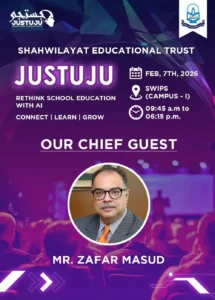
On Saturday, February 7, 2026, the Shahwilayat Educational Trust (SWT) hosted a pivotal day-long conference at Shahwilayat Public School (Campus 1) in the Federal B Area of Karachi. Titled “Justuju — Rethink School Education with AI,” the event was designed as a proactive response to the disruptive potential of generative artificial intelligence in the classroom.
The summit was born from a need to bridge the gap between rapid technological advancement and traditional pedagogical methods. The primary goal was to explore how AI could be integrated as a “thinking partner” to enhance learning rather than a shortcut that erodes cognitive depth. The theme, “Justuju” (meaning “The Quest”), symbolized an ongoing journey for educators to evolve their teaching philosophy for the 21st century.
The conference transformed the Federal B Area campus into a hub for Karachi’s intellectual elite. The guest list was carefully curated to include a balance of corporate leadership, academic excellence, and government authority:
- Chief Guest: Zafar Masud, whose closing address linked educational reform to national economic stability.
- Academic Leadership: Prof. Farid F. Panjwani (Aga Khan University) provided the sociological framework for tech adoption.
- Government Perspective: Dr. Fouzia Khan (Sindh Education Department) outlined state-level digital leadership investments.
- Industry Voice: Salman Akhtar (Techlogix) and Jawwad Fareed Ahmed (AlChemy Tech) brought “on-the-ground” technical realities to the stage.
The day was structured to move from high-level philosophy to practical, hands-on application.
- Opening Plenaries: Set the stage regarding the ethics and societal impacts of technology.
- Panel Discussions: Focused on the “Dualities of AI”—balancing the massive opportunities for personalized learning with the risks of data privacy and “thinking debt.”
- Technical Demonstrations: Titled “From Chalk to AI,” these sessions led by Dr. Fatima Dar and Dr. Mohsin Raza showcased how teacher training for AI integration could automate administrative tasks to reclaim time for student-centric emotional support.
The event concluded with a set of formal recommendations, including the Charter of Society for AI use, marking a shift from government-led regulation to community-driven ethical standards. By hosting “Justuju Rethink School Education with AI,” the Shahwilayat Educational Trust has set a new benchmark for how private educational institutions in Pakistan can lead national discourse on digital transformation.
Learn more on Shahwilayat Facebook Page
Justuju Rethink School Education with AI: Zafar Masud’s Strategic Roadmap for Pakistan
On Saturday, February 7, 2026, a critical dialogue regarding the future of Pakistan’s academic landscape took place in Karachi. The event, titled “Justuju Rethink School Education with AI,” hosted by the Shahwilayat Educational Trust, brought together thought leaders, educators, corporate titans, and policymakers. In an era where artificial intelligence is rapidly reshaping every sector, the conference sought to answer a fundamental question: How can Pakistan integrate these powerful tools without compromising the cognitive competence and moral development of its future generations?
The closing keynote address delivered by Zafar Masud, President & CEO of The Bank of Punjab and Chairman of the Pakistan Banks Association, provided a pragmatic and deeply philosophical roadmap. His address went beyond mere technological adoption; it was a call to redefine the relationship between human intelligence and machine capability in the classroom.
Masud’s speech highlighted that the theme, “Justuju Rethink School Education with AI,” is not merely about deploying gadgets in schools. It is about the profound architecture of how young minds are formed, how judgment matures, and how attention—a scarce commodity in the digital age—is trained. The conference served as a crucial platform to debate whether AI will become the ultimate equalizer in a fractured educational system or an accelerant for superficial learning.
This article delves deep into the key themes emerging from the conference, analyzing Masud’s strategic vision for a hybrid educational model, the infrastructural realities of Pakistan, and the ethical frameworks required to navigate this brave new world.
The Core Philosophy of AI: Thinking Partner vs Substitute
At the heart of Zafar Masud’s address was a critical distinction that serves as the philosophical anchor for integrating AI into education. He argued that generative AI—tech that can simulate reasoning and produce instant answers—must be positioned as a “thinking partner” rather than a “thinking substitute.”
This distinction is vital. A substitute does the heavy lifting for the student, bypassing the necessary mental struggle that leads to genuine understanding. A partner, conversely, augments human capability, speeds up friction points, and offers new perspectives, but leaves the final judgment and cognitive effort to the human.
The Danger of the “Bypass”
Masud warned that if used superfluously, AI becomes a “bypass around thinking.” He drew attention to a growing body of international research indicating that too much technology too early in a child’s development weakens attention spans, fosters shallow reading patterns, and reduces “reasoning endurance.”
In a world dominated by instant gratification, the ability to engage in deep, prolonged thought is becoming a competitive advantage. If educational institutions allow AI to provide instant answers without requiring students to interrogate the process, they risk producing a generation capable of accessing information but incapable of generating original insight. “Depth comes from effort, not automation,” Masud asserted. “Brain growth happens through struggle, not shortcuts.”
The Vertical Framework: Age-Appropriate Exposure
To counter these risks, Masud proposed a “vertical framework” for AI adoption, advocating for a scaffolded approach based on a student’s developmental stage:
- Foundation Years (Low-Tech): In early education, cognitive development must remain human-led. The focus should be on building foundational skills that require patience and physical engagement: deep reading of printed text, handwriting, storytelling, and imagination. Masud argued that excessive screen exposure in these formative years is detrimental.
- Middle Years (Supervised Tech): As students mature, technology should be introduced under strict supervision. The focus shifts to guided digital research, teaching verification skills, and questioning AI outputs.
- Senior Years (Structured Fluency): By higher education, students must be fluent in AI. This involves advanced skills like prompt engineering, error detection, understanding algorithmic bias, and using AI as a collaborator for complex problem-solving under human direction.
This nuanced approach ensures that the technology enters the educational equation only after the human mind is sufficiently formed to handle it, not before.
Bridging the Digital Divide: Infrastructure and Realities
While the philosophical framework is essential, the “Justuju Rethink School Education with AI” conference also tackled the harsh ground realities of Pakistan. The country faces a staggering challenge: over 26 million out-of-school children and a dilapidated physical infrastructure in many regions. In a fiscally struggling economy, high-tech solutions often seem like a distant dream for the majority.
Masud acknowledged that the affordability of technology remains a massive barrier. He argued that public-private partnerships are the only viable path forward to bridge this chasm.
The Chromebook Assembly in Pakistan
A significant portion of the address highlighted concrete steps being taken to address hardware accessibility. Masud detailed a strategic partnership involving the Government of Pakistan, the National Radio Telecommunication Corporation (NRTC), and Google for Education.
This collaboration has led to the launch of Pakistan’s first Chromebook assembly line in Haripur. The facility is set to produce 500,000 Chromebooks annually by 2026. This localization of manufacturing is a game-changer, making AI-ready hardware significantly more affordable for students nationwide than importing expensive devices.
Furthermore, pilot programs are already underway. Masud noted that 424 schools in Islamabad have been digitized, bringing 22,000 users onto the global Google for Education portal. In Punjab, “smart labs” equipped with 200,000 Chromebooks are being established, alongside a Center of Excellence to serve as a blueprint for broader AI adoption.
These infrastructural developments are crucial. Without accessible hardware and reliable connectivity, any discussion about AI in education remains theoretical for the vast majority of Pakistani students.
The Hybrid Learning Model: The Future of the Pakistani Classroom
The consensus emerging from the “Justuju” conference is that the future of education is neither entirely analog nor entirely digital—it is hybrid. Masud cautioned against the allure of total digitization, citing international examples from OECD countries where schools that digitized too quickly are now reverting to printed textbooks and handwritten practice to improve comprehension.
The strongest emerging global model, and the one advocated for Pakistan, is a hybrid approach that balances the best of both worlds:
- Human-Led Core: Teacher-led concept delivery, project-based applications, empathy, moral guidance, and final interpretation of information remain strictly in the human domain.
- AI-Assisted Support: AI is used for personalized practice, instant feedback on routine tasks, and real-world problem-solving simulations that would be impossible in a traditional setup.
Protecting the “Attention Infrastructure”
A critical component of this hybrid model is what Masud termed protecting the “attention infrastructure.” He argued that attention is now the scarcest learning resource. Schools must actively design their days to combat digital distraction. This includes introducing long, uninterrupted reading blocks, “deep work” sessions, and mandatory device-free intervals for reflection. A system that does not actively protect attention cannot produce deep thinkers, regardless of the advanced AI tools at its disposal.
Expert Insights from the Justuju Conference
The “Justuju Rethink School Education with AI” conference was a convergence of diverse expert perspectives, each adding a layer of complexity to the primary theme.
Prof. Farid Panjwani: The Social Context of Tech
Prof. Farid F. Panjwani, Dean of the Institute for Educational Development at Aga Khan University, emphasized in his keynote that technology does not exist in a vacuum. It is embedded in a social context. He warned against technological determinism—the idea that tech will automatically solve educational problems. He stressed that without addressing the underlying social and pedagogical issues, AI could simply amplify existing inequalities.
Javed Jabbar: Equity and Access
Former Senator and Federal Minister Javed Jabbar highlighted the immense disparities in the Pakistani education system. He argued that the “Justuju” for AI must be coupled with a “Justuju” for equity. If elite private schools integrate cutting-edge AI while public schools lack electricity, the societal divide will become insurmountable. He called for policy frameworks that prioritize access for the most marginalized communities.
Salman Akhtar: Breaking Language Barriers
Salman Akhtar, CEO of Techlogix, spoke to the practical applications of AI, particularly in the context of Pakistan’s linguistic diversity. He noted that Generative AI’s ability to translate and localize content instantly could be revolutionary for a country where English is a barrier for many. AI could allow students to learn complex concepts in Urdu or regional languages, democratizing access to high-quality knowledge.
Dr. Fouzia Khan: Government’s Role in Upskilling
Representing the public sector, Dr. Fouzia Khan, Chief Advisor to the Sindh Education & Literacy Department, acknowledged the government’s behemoth task. She emphasized that state-level interventions are focusing on creating “digital leaders” within the teaching workforce, recognizing that bureaucratic machinery moves slowly but is essential for scale.
Empowering the Modern Teacher: The “Future-Ready Staffroom”
A recurring theme throughout the conference, and one strongly endorsed by Zafar Masud, was the shift in focus from “future-ready classrooms” to “future-ready staffrooms.”
The consensus was clear: the best way out of Pakistan’s educational quagmire is not just to educate students on tech, but to educate teachers on how to leverage it for efficiency. Teachers in Pakistan are often overburdened with administrative tasks—grading, lesson planning, reporting—which eats into time that could be spent on mentorship and personalized instruction.
AI tools can automate much of this drudgery. During the conference, demonstrations by experts showed how teachers could use generative AI to create lesson plans in minutes, generate differentiated problem sets for students of varying abilities, and analyze assessment data to identify learning gaps instantly.
By offloading cognitive drudgery to AI, teachers are freed up to do what humans do best: connect empathetically with students, understand their emotional context, and inspire curiosity. Teacher training programs must therefore pivot aggressively toward AI literacy, making them the primary agents of this change.
The Role of Policy and Ethics: A Charter of Society
One of the most provocative points raised by Zafar Masud concerned the regulation of AI. In an era where calls for government regulation of tech are growing globally, Masud offered a contrarian view.
He implored the audience: “For God’s sake, keep the government away from AI.” His argument was rooted in the practicality that bureaucratic structures are inherently slow and often lack the specialized knowledge to regulate rapidly evolving technologies effectively. Heavy-handed government intervention could stifle innovation and create perverse incentives.
Instead, Masud advocated for a self-regulating approach driven by educational institutions, the private sector, and civil society. He called for a “Charter of Society” for AI—a set of shared ethical principles and societal values that guide how these powerful tools are used. Drawing a parallel to the UK’s unwritten constitution, he argued that strong societal norms and individual responsibility are more effective regulators than four pages of legislation. This puts the onus on schools and parents to define ethical boundaries, ensuring AI use remains constructive rather than destructive.
Conclusion: The Irreplaceable Human Element
The “Justuju Rethink School Education with AI” conference concluded not with a blind endorsement of technology, but with a balanced, human-centric vision. Zafar Masud’s final message resonated deeply with the assembled educators: if we get this right, AI will elevate education; if we get it wrong, it will accelerate learning while reducing understanding.
The choices made today—by policymakers regarding infrastructure, by principals regarding curriculum, and by teachers regarding classroom practice—will define the cognitive landscape of future generations. The ultimate goal of education remains unchanged: the shaping of character, the maturation of judgment, and the cultivation of empathy. AI is a powerful collaborator in this journey, but the steering wheel must remain firmly in human hands. The “Justuju” (quest) continues, but now with a clearer map for navigating the algorithmic age.