
Zafar Masud Interview on Ethical Leadership by SAAM
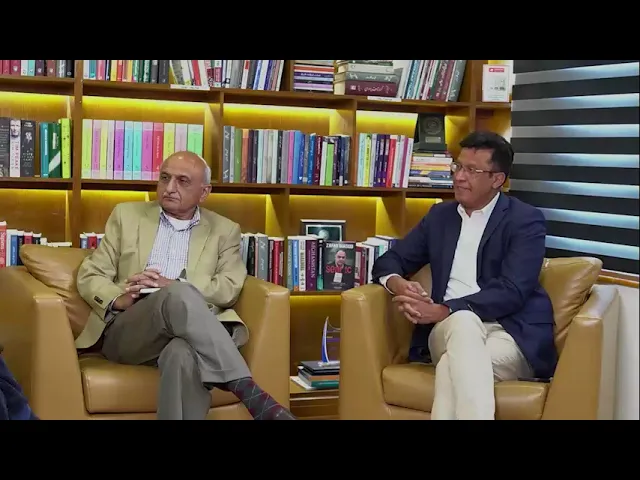
In this insightful interview hosted by the South Asian Academy of Management, Mr. Zafar Masud, President & CEO of the Bank of Punjab, shares his profound perspective on Ethical Leadership.
Discover how personal values, family legacy, and the life-altering experience of surviving the 2020 PIA plane crash have shaped his approach to management. From maintaining integrity in the public sector to fostering a culture of trust and empathy within a major financial institution, Mr. Masud provides invaluable lessons for aspiring leaders and seasoned executives alike.
Introduction and Context (00:00 – 01:40)
The hosts, Dr. Abdur Rahim Nasir and Dr. Muhammad Zahur, introduce Zafar Masud as the third guest in their series on ethical and value-driven leadership (following Syed Babar Ali and Dr. Ishrat Husain). They aim to map out local role models who have navigated the “daunting task” of remaining ethical within the Pakistani corporate and public sectors.
Foundations of Character (01:41 – 08:30)
Masud begins by stating that ethics are primarily a product of upbringing and family.
The Utility Meter Lesson: He shares a pivotal childhood story. While a student at FC College, he excitedly told his father he found a way to “tweak” the electricity meter to run multiple air conditioners for the price of one. His father’s response was a sharp reality check: he suggested they simply go buy a gun and rob a bank instead, as it was the same thing—stealing. This “embarrassing moment” defined Masud’s understanding that there are no “small” ethical compromises.
Empathy: He credits his mother for instilling a sense of empathy and compassion, which he believes is the primary requirement for any leadership role.
Intellectual and Ancestral Legacy (08:31 – 11:40)
The conversation shifts to Masud’s illustrious family background (descendants of the Amroha family, including figures like Rais Amrohvi and Jon Elia).
Standing up to Power: He recalls his uncle, Taki Amrohvi, who resigned from the Jang newspaper because he refused to let the Ayub Khan government dictate editorial policy, despite having a daughter’s wedding to fund.
Jon Elia’s Refusal: He mentions how the poet Jon Elia once refused a presidential award because he didn’t respect the authority of the person giving it—a lesson in not bowing down to power for personal gain.
Professional Journey and “The Line” (11:41 – 21:50)
Masud discusses his “360-degree” career across multinational banks (Citibank, American Express), regional banks, and the public sector.
The Blue Passport & Land Cruiser: Upon joining the public sector as DG of National Savings, he was immediately offered a “Blue Passport” and a government Land Cruiser. He rejected both, viewing them as “hooks” that make a leader comfortable and thus more likely to compromise when faced with difficult decisions later.
Protecting the Organization: He explains that a leader must draw a “line” they will never cross. He cites a major career crossroad where a Finance Minister asked him to “accommodate” a person in exchange for a prestigious promotion. Masud chose the interest of the organization over his own career advancement and declined the request.
Philosophy and Role Models (21:51 – 33:50)
Masud describes himself as a “non-ritualistic/agnostic” person who views religious and historical figures through a humanistic lens.
Historical Examples: He draws inspiration from the Prophet Muhammad’s (PBUH) fair business principles, Hazrat Ali’s letters on governance, and Imam Hussain’s sacrifice against tyranny.
Sacrifice: He compares Imam Hussain to Socrates and Jesus, noting that Hussain’s sacrifice was even greater because he watched his loved ones suffer rather than give up his principles. He uses these as “reference points” for the courage needed in modern leadership.
Leading the Bank of Punjab (33:51 – 48:30)
Since joining the Bank of Punjab (BOP), Masud has focused on institutionalizing ethics.
Fearlessness: He admits that after his 2020 plane crash, he became “too fearless,” which he has to balance with tact so as not to hurt the organization.
Empowerment and Accountability: He is a major supporter of decentralization. Under his tenure, BOP has separated 1,000 underperforming employees through a rigorous, system-driven process—refusing to succumb to immense external pressure to reinstate them.
Zero Tolerance: He emphasizes zero tolerance for harassment. He mentions a case where a lady withdrew a complaint due to pressure from an influential harasser. Masud, having seen video evidence, insisted the harasser be fired regardless of the lady’s withdrawal or political phone calls.
Internal Policies: BOP has a gift policy where anything over 15,000 PKR must be surrendered. Masud also voluntarily declares his personal shareholding to the board every quarter, even though it isn’t a legal requirement.
The 2020 Plane Crash and “Seat 1C” (48:31 – 56:35)
Masud reflects on surviving the PIA Flight 8303 crash.
Immediacy: The experience made him “super impatient” to do good now, realizing that the next minute isn’t guaranteed.
Human Goodness: He recalls the strangers who pulled him from the burning wreckage, risking their own lives without knowing his status or wealth. This reinforced his belief that relationships and human goodness are life’s only true currency.
The Protesting Union: Interestingly, he notes that members of a union that had been protesting against him at National Savings were the first to show up at the hospital to offer blood, showing that people respect a leader who is fair, even if they disagree with his policies.
Advice for Future Leaders (56:36 – End)
Masud concludes with three main pieces of advice for MBA students and young professionals:
Avoid Shortcuts: They hounded you eventually. You are a “long-term player,” and short-term gains are immaterial.
Trust the Process: What you deserve will come to you, even if it takes a “detour.” Don’t be impatient with appraisals.
Legacy: People won’t remember your title or wealth; they will only remember how your position benefited them.
Full Video
This video was originally uploaded on SAAM YouTube Channel