
Summary of Tea & Talk Podcast — Nasira Zuberi with Zafar Masud
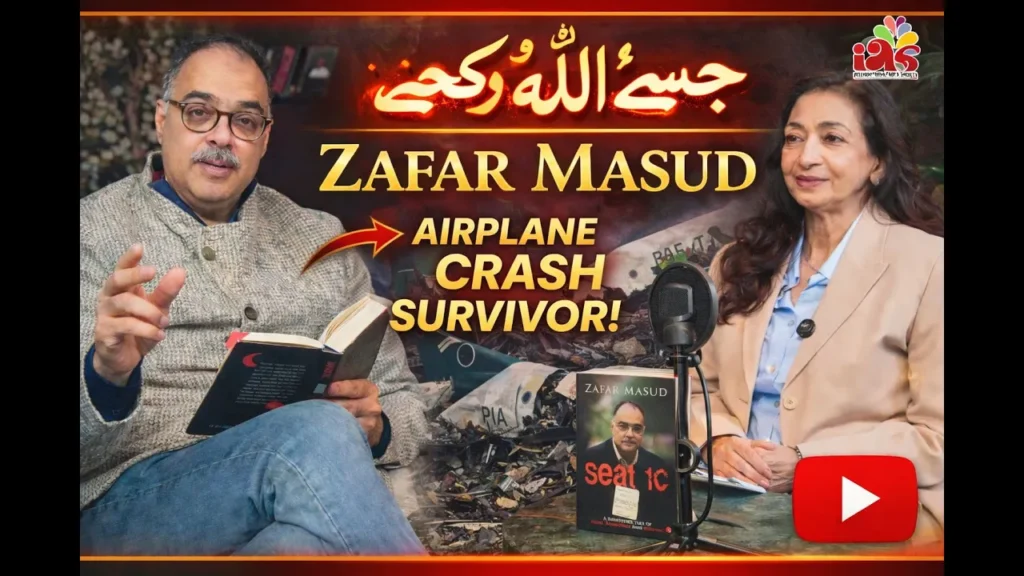
In this “Tea & Talk” podcast hosted by Nasira Zuberi of the International Arts Society (IAS), Zafar Masud, President of the Bank of Punjab (BOP), shares a profound account of his life as a survivor of the 2020 PIA plane crash and discusses his professional mission.
In this Tea & Talk Podcast interview, Zafar Masud shares a profound reflection on surviving the 2020 PIA plane crash, describing the “borrowed time” he now lives on as a mandate to serve others. He discusses his book, Seat 1C, and his mission to humanize the financial sector through initiatives like the Kisan Card for farmers and electric bike schemes for students. Beyond his personal miracle, Masud outlines a vision for Pakistan’s economic stability rooted in judicious taxation and financial inclusion, ultimately encouraging resilience by viewing life’s adversities as essential opportunities for growth and refinement.
Tea & Talk Podcast Commentary
The Aura of Resilience: An Introduction to Zafar Masud
In the landscape of modern Pakistani leadership, few figures command as much respect and intrigue as Zafar Masud. His name is synonymous with professional excellence in the financial sector, yet it is equally intertwined with a narrative of survival that borders on the miraculous. As the President of the Bank of Punjab and a key figure in Pakistan’s economic policy circles, Masud represents the intersection of cold, hard data and a profound, lived-in humanity. The International Arts Society’s “Tea & Talk” series recently provided a platform to explore this multifaceted personality—not just as a banker or a survivor, but as a philosopher of the human condition.
The conversation began by acknowledging Masud as a “charismatic” and “miraculous” individual. It is rare to see a corporate leader described in such spiritual terms, but for Masud, the labels are earned. Having survived a catastrophic aviation disaster that claimed the lives of almost everyone else on board, he has become a symbol of hope and a living testament to the unpredictability of fate. However, as the discussion unfolded, it became clear that while the crash is a defining chapter of his life, it is his response to that survival—his dedication to “paying it back” through systemic reform and social empowerment—that truly defines his character.
The Miracle of Survival: Thirty Seconds Between Life and Death
The year 2020 is etched into the global consciousness for many reasons, primarily the COVID-19 pandemic. In Pakistan, however, it is also remembered for the tragic PIA flight PK-8303. Among the devastation, Zafar Masud emerged as one of only two survivors. During the talk, he revisited those final moments before the impact—a period he describes as thirty seconds that felt like an eternity.
In those moments, the typical optimism of a traveler—the belief that the pilot will pull up, that the landing gear will eventually lock, that the “go-around” is just a standard procedure—fades into a stark realization of mortality. Masud reflects on the “ephemeral nature of life” with a clarity that only comes from staring directly into the abyss. He notes that while we all know death is inevitable, we rarely live with the conscious awareness of its proximity. For him, that proximity was a physical, tangible presence as the aircraft descended toward the residential streets of Karachi.
See also: Zafar Masud’s Speech at PSRD Gala Dinner 2025 | Pakistan Society of Rehabilitation Differently Abled
The Philosophy of the Internal Court: Judge, Accused and Counsel
One of the most striking revelations from Masud’s experience is his description of the “internal court” that forms in the mind when death is imminent. He describes a state of near-death experience where the soul stands trial. In this courtroom, there are no external jurors or biased witnesses. Instead, Masud explains that he found himself playing three roles simultaneously: the accused, the judge, and the defense counsel.
This psychological phenomenon serves as a total accounting of one’s life. Every action, every omission, and every intention is laid bare. As the accused, he faced the weight of his own shortcomings; as the judge, he weighed the morality of his existence; and as the counsel, he sought to find the grace in his journey. This profound self-reflection has clearly shaped his post-crash worldview. He suggests that if more people lived with the awareness that they will eventually have to stand in this internal court, the world would be a far more compassionate and honest place. He encourages others to consider their own “accountability to self” long before the moment of crisis arrives.
Seat 1C: Documenting the Indescribable
The title of Masud’s book, Seat 1C, refers to his physical location on that fateful flight. But the book is more than a memoir of a disaster; it is a document of transformation. Since its release, the book has resonated globally, leading to dozens of podcasts and talks. Masud admits that while he is the head of major financial institutions, he often feels that his most significant contribution is the story captured in those pages.
The book serves as a bridge between the physical reality of the crash and the spiritual journey of the recovery. Writing it was not merely a therapeutic exercise but a fulfillment of what he perceives as a divine mandate. He believes he was given a second chance specifically to tell this story—to bridge the gap between those who have passed and those who remain. By documenting the “near-death experience,” he provides a roadmap for others to understand the value of time and the weight of their own legacies.
A Legacy of Letters: The Literary DNA of the Masud Family
Masud’s ability to articulate his experiences is no accident. He belongs to a family of profound literary pedigree. During the interview, he discussed his heritage, noting that his family has produced over fifty books across several generations. He is the descendant of figures like Rais Amrohvi and Jon Elia, and the son of the respected Zawar Saeed.
While many might attribute his success to “DNA,” Masud views it more as an orientation provided by his upbringing. He grew up in an environment where the written word was the primary currency of expression. This background gave him the tools to process his trauma through narrative. Even before the crash, there was a subconscious drive to contribute to the family’s literary legacy. The crash simply provided the most urgent and necessary subject matter. This literary tradition also informs his banking style—he is a communicator who understands that behind every financial statistic is a human story waiting to be told.
Humanizing the Ledger: Redefining Banking in Pakistan
As the President of the Bank of Punjab, Masud has pioneered a philosophy he calls “Humanizing Economics.” In a country where the financial sector is often viewed with skepticism or as an ivory tower for the elite, Masud has worked to bring the bank to the people. He argues that banking should not just be about profit margins and interest rates, but about social welfare and national development.
His approach is rooted in the belief that financial inclusion is a fundamental right. He sees the bank as a tool for empowerment rather than just a vault for capital. By focusing on sectors that were previously ignored—small farmers, women entrepreneurs, and students—he is attempting to rewrite the social contract between the Pakistani people and their financial institutions. This shift is not just about charity; it is about creating a sustainable, inclusive economy where the “common man” has a stake in the system.
The Kisan Card Revolution: Empowering the Agrarian Backbone
Agriculture is the backbone of Pakistan’s economy, yet the small farmer has historically been the most neglected stakeholder. Masud detailed the success of the “Kisan Card” (Farmer’s Card) initiative, which has revolutionized agricultural lending. The Bank of Punjab has approved approximately 94 billion PKR in lending through this scheme, impacting nearly a million farmers.
One of the most significant hurdles in agricultural lending is the perception of risk—the fear that small farmers will not repay their loans. Masud debunked this myth with hard data. He revealed that the recovery rate for the first cycle was an astounding 98.5%. This proves that when given a fair chance and a structured process, the “poor” are often the most reliable borrowers. By providing these loans, the bank is not just helping individuals; it is ensuring food security and economic stability for the entire province. Masud’s focus on “verification and process” has turned a high-risk sector into a model of success.
Supporting the Engine of Growth: SMEs and Economic Resilience
Beyond agriculture, Masud has turned his attention to Small and Medium Enterprises (SMEs). He describes SMEs as the “backbone” of any developing economy, as they are the primary drivers of employment and innovation. The Bank of Punjab has disbursed 93 billion PKR in new capital to this sector, representing a massive portion of the total SME lending in the country.
Masud believes that by supporting these small businesses, the bank is fueling the exporting industry and reducing the country’s reliance on imports. His strategy involves moving away from the “safe” lending practices of the past, where banks only dealt with large, established conglomerates. Instead, he is taking calculated risks on the entrepreneurs who are building the future of Pakistan’s marketplace.
Breaking the Glass Ceiling: Gender-Inclusive Finance and Women’s Empowerment
A significant portion of the conversation was dedicated to gender-inclusive finance. Masud pointed out that the Bank of Punjab now accounts for nearly 70-75% of the total industry-wide financing for women in certain sectors. This commitment to women’s entrepreneurship has earned the bank numerous awards from the State Bank of Pakistan.
Masud understands that empowering women is not just a social cause; it is an economic necessity. When women are financially independent, they reinvest in their families and communities, creating a multiplier effect for economic growth. By removing the barriers to entry—such as lack of collateral or restrictive banking hours—Masud is making it possible for thousands of Pakistani women to transition from the informal economy to the formal financial system.
Mobility for the Future: The Student Bike Initiative and Green Energy
In a particularly inspiring segment of the talk, Masud discussed the bank’s initiative to provide bikes to students. To date, 19,000 bikes have been distributed, with a significant emphasis on green energy. Out of these, 5,000 are electric bikes, and the majority of the recipients are female students.
For a student in Pakistan, a bike is more than just a vehicle; it is a gateway to education and employment. It provides the mobility and safety necessary to attend university and pursue a career. Masud expressed immense personal satisfaction in seeing female students riding these bikes on the streets, noting that this visible change in society is far more rewarding than any year-end bonus. This initiative aligns with global trends toward sustainability while addressing local needs for transport and gender equity.
Cultivating a Culture of Empathy: Moving Beyond the Bonus
Perhaps Masud’s greatest achievement at the Bank of Punjab is the cultural transformation he has led within the organization. He has worked to instill a sense of empathy in his staff, encouraging them to find satisfaction in the lives they change rather than just the numbers they produce.
He shared a unique management practice where he writes letters to the families of employees who perform exceptionally well. By acknowledging the support of a spouse or the upbringing of a parent, he creates a holistic environment where employees feel valued as human beings. He believes that when employees feel that their work has a higher purpose—such as helping a farmer or a student—their productivity and loyalty naturally increase. This “culture of care” is what Masud hopes will be his lasting legacy at the bank.
The Macroeconomic Blueprint: Bridging the Gap Between Policy and People
The discussion eventually turned toward the broader economic challenges facing Pakistan. Drawing on his experience with the World Bank, the IMF, and various national committees, Masud offered a blueprint for reform. He emphasized that the current economic system is disconnected from the reality of the average citizen.
He calls for “Priority Sector Financing,” where the government and banks work in partnership to support the most vulnerable. He argues that the scale of poverty in Pakistan—with nearly 45% of the population living below the line—is too large to be addressed by corporate social responsibility (CSR) alone. Instead, social welfare must be baked into the very structure of the economy. This requires a fundamental shift in how the government allocates its resources and how it incentivizes private banks to participate in national development.
The Taxation Dilemma: Toward a Judicious and Broad-Based System
A recurring theme in Masud’s economic analysis is the need for a “judicious” taxation system. He pointed out that Pakistan’s tax-to-GDP ratio is stuck at around 10%, whereas it needs to be at least 15-16% for the country to be fiscally viable. However, he cautioned against simply increasing the tax burden on existing taxpayers, such as the banking industry, which currently faces an effective tax rate of over 60%.
Instead, he advocates for broadening the tax net. This includes bringing the agricultural sector and the retail sector into the formal tax system. He acknowledged the political difficulty of this—given that many lawmakers are themselves large landowners—but insisted that there is no other way to create the “fiscal space” necessary for spending on health and education. Without a broad-based tax system, the government will continue to rely on borrowing, which stifles the private sector and drives up inflation.
The Theory of the Leaking Hand: Solving the Liquidity Crisis
Masud introduced a compelling economic theory he calls “Leaking Found in Hand and Dry Bond.” In simple terms, he argues that because the taxation system is “leaking”—due to evasion and exemptions—the government’s bond remains “dry” or empty. This forces the government to borrow heavily from commercial banks to cover its deficit.
This cycle is devastating for the economy. When the government consumes all the available credit, there is nothing left for the private sector to borrow. This “crowding out” effect prevents businesses from growing and creates a liquidity crisis. Masud suggests that by plugging the leaks in the tax system and digitizing the economy, the government can reduce its reliance on bank borrowing, thereby freeing up capital for the “real” economy—the farmers, the small businesses, and the entrepreneurs.
Borrowed Heaven: Living with Purpose and Poetry
Toward the end of the talk, the conversation shifted back to the personal and the poetic. Masud read a passage from his book, reflecting on the song “Borrowed Heaven” by The Corrs, which he listened to during his recovery. The lyrics—”All body, all skin, all bone, borrowed”—perfectly encapsulate his current state of mind.
He views his life not as a possession, but as a loan that must eventually be repaid. This “borrowed time” philosophy drives his urgency. He feels that he does not have the luxury of wasting time or pursuing purely selfish goals. Every day is an opportunity to honor the “miracle” of his survival by making a tangible difference in the lives of others. This poetic sensibility, combined with his professional rigor, makes him a unique figure in Pakistani public life.
Embracing Adversity: A Message to the Next Generation
In his concluding remarks, Masud addressed the youth of Pakistan, who often feel disillusioned by the country’s challenges. He shared a message of resilience, using a couplet that translates to: “If life doesn’t get tangled, how will it be solved? If it doesn’t scatter, how will it shine?”
He believes that adversity is an essential part of the human experience. It is not something to be feared, but something to be faced and integrated into one’s character. For Masud, the crash was the ultimate “tangling” of life, but it was also the process that allowed him to “shine” in a new way. He encourages young people to view their struggles not as dead ends, but as the friction necessary for growth.
Conclusion: The Living Legacy of Zafar Masud
The Tea & Talk Podcast dialogue between Zafar Masud and the International Arts Society was more than an interview; it was a masterclass in purposeful living. From the cockpit of a falling plane to the boardroom of a major bank, Masud’s journey is one of incredible highs and devastating lows. Yet, throughout it all, he has remained grounded in his values and his heritage.
His story serves as a reminder that leadership is not just about power or profit, but about the impact one leaves on the world. Whether it is through the Kisan Card, the electric bikes for students, or the pages of Seat 1C, Zafar Masud is building a legacy of empathy and reform. He stands as a beacon for a new kind of Pakistan—one that is modern, inclusive, and deeply aware of the “borrowed heaven” we all inhabit.
The Tea & Talk Podcast was originally posted on International Arts Society’s YouTube Channel on January 9, 2026
Nasira Zuberi and the International Arts Society
A Synthesis of Media and Literature
Nasira Zuberi is a prominent figure in Pakistan’s intellectual landscape, distinguished by her dual success as a senior journalist and an acclaimed Urdu poet. With a career spanning over two decades, she has navigated the high-pressure world of business and political journalism while maintaining a profound literary presence. Central to her recent contributions is her collaboration with the International Arts Society (IAS), a cultural organization dedicated to fostering intellectual dialogue and promoting literary excellence.
Nasira Zuberi: The Poet-Journalist
Zuberi’s journey began in print journalism in 1988 at the Business Recorder, Pakistan’s first business daily. Over the years, she transitioned into electronic media, playing a pivotal role in the launch of major news channels including Geo News, Aaj News, and News One. Her professional rigor in economic and parliamentary reporting has always been balanced by her literary pursuits, a feat she credits to her upbringing in a literary family and the support of her husband, Shahab Zuberi.
Her poetic contributions are marked by a unique voice that often explores themes of self-discovery, identity, and the human condition. Unlike many of her contemporaries, her work has been noted for its distinct lack of traditional “complaints against men,” focusing instead on broader philosophical reflections. Her major publications include:
- Shagoon (1990s)
- Kaanch Ka Chiragh (2012)
- Teesra Qadam (2017)
- Be-mausami Khwahishein (Unseasonal Desires, 2025)
The International Arts Society (IAS)
The International Arts Society operates as a platform for cultural and intellectual exchange. Through its flagship initiatives, such as the “Tea & Talk” podcast and hosted literary ceremonies, the IAS bridges the gap between different sectors of society—including banking, arts, and politics. The society aims to preserve and promote Urdu literature while providing a forum for leaders and artists to share their life experiences and professional insights.
In August 2025, the IAS gained significant attention for hosting the exclusive launch of Nasira Zuberi’s latest book, Be-mausami Khwahishein. This event highlighted the society’s role as a catalyst for cultural vibrancy, bringing together journalists, poets, and public figures to celebrate the evolution of contemporary Urdu verse.
A Shared Vision for Cultural Dialogue
The partnership between Nasira Zuberi and the IAS exemplifies the modern “Salon” culture in Pakistan. By utilizing digital platforms and intimate talk series, they ensure that the wisdom of seasoned professionals and the nuances of classical arts remain accessible to the younger generation. Whether through a discussion on the economic impact of the Bank of Punjab or the delicate imagery in a Ghazal, the collaboration underscores a commitment to a well-rounded, enlightened society.