
Seat 1C Book Launch at Jashn-e-Jaun Elia — Summary
In this deeply moving session from Seat 1C Book Launch at Jashn-e-Jaun Elia in Faisalabad, moderator Hammad Ghaznavi hosts a profound dialogue with Zafar Masood, the sole survivor of the tragic PIA Flight 8303 crash on May 22, 2020. While ostensibly a book launch for Masood’s latest work, the conversation transcends the written word to explore the “book of life”. Zafar Masood recounts the harrowing “30-second story” of the plane’s final moments, sharing the near-death experience that forced him to reflect on his entire existence.
See also: Jashn-e-Jaun Elia 2026 | Zafar Masud’s Informative Economy Session on Day 2
The Literary Canvas of Survival at the Ashiqabad Festival 2026 in Faisalabad
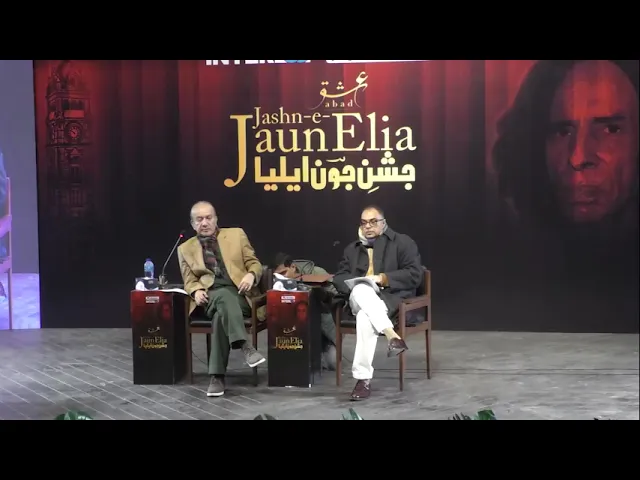
In the cultural heart of Pakistan, amidst the vibrant tapestry of the Ashiqabad Festival 2026 in Faisalabad, a session of profound depth and existential inquiry unfolds, marking a significant moment in literary and intellectual discourse. This gathering, dedicated to the Jashn-e-Jaun Elia, serves as the host for the Seat 1C Book Launch, a work that transcends the boundaries of a mere memoir to become a treatise on life, death, and the miraculous interim of survival.
The atmosphere is charged with a solemn curiosity as the audience settles in, aware that they are not merely attending a book launch but bearing witness to the testimony of a man who returned from the precipice of existence. The stage is set for a dialogue that promises to navigate the turbulent waters of trauma and the serene shores of realization, all anchored within the prestigious Ashiqabad Festival 2026 in Faisalabad.
The Opening Dialogue and the Essence of the Book of Life
The session commences with the moderator, Hammad Ghaznavi, setting a tone of reverence and anticipation. He articulates that while the occasion is formally the Seat 1C Book Launch, the conversation is destined to encompass much more than the printed pages of Zafar Masood’s “Seat 1C“. Ghaznavi posits that the true subject of the day is the “Book of Life“—the unwritten, chaotic, and often tragic narrative of existence itself. He introduces Zafar Masood not just as an author or a banker, but as a living miracle, a man whose life story was rewritten in a matter of seconds.
The Jashn-e-Jaun Elia provides the perfect backdrop for such a discussion, given Jaun Elia’s own preoccupation with the paradoxes of being. Ghaznavi draws a parallel between the contradictory nature of Jaun Elia—a man who was a conglomerate of conflicts, a Shia scholar yet a graduate of Deoband, a narcissist who refused to comb his hair yet desired beauty—and the enigmatic survival of Zafar Masood. This introduction at the Ashiqabad Festival 2026 in Faisalabad frames the survivor as a figure of destiny, someone whose continued breath is a question mark posed to the universe.
The Narrative of May 22: A Descent into the Abyss
As the dialogue shifts to the protagonist of the Seat 1C Book Launch, Zafar Masood takes the microphone to recount the events of May 22, 2020. He describes the day with a chilling normalcy—a Friday, Jumma-tul-Wida, a public holiday laden with spiritual significance. He speaks of his own habits as a terrible traveler, one who typically rushes to the airport at the last minute, yet on this fateful day, he arrived early, driven by the anticipation of Eid and a reunion with his parents in Karachi.
The flight from Lahore, initially uneventful, became the vessel for a journey into the unknown. Masood details the technical anomaly, the pilot’s decision to abort the first landing attempt, and the subsequent, catastrophic failure of the engines upon the go-around. The description becomes visceral as he recalls the cockpit door flying open, a jarring deviation from protocol that offered him a terrifying glimpse of the approaching urban landscape.
Through the windscreen, he saw not the runway, but the encroaching rooftops of a residential colony, a sight that signaled the inevitability of the crash. This harrowing recounting silences the hall at the Ashiqabad Festival 2026 in Faisalabad, bringing the audience face-to-face with the fragility of life.
The Philosophy of the Thirty-Second Story
Central to the discussion at the Jashn-e-Jaun Elia is what Masood terms the “Thirty-Second Story.” He posits that for some, the defining epoch of their lives spans years or months, but for him, the entirety of his existence was compressed into the half-minute preceding the impact. In those fleeting moments, as the plane hurtled towards the earth, Masood experienced a profound phenomenon often cited in near-death experiences: the cinematic replay of his life. However, his narrative at the Seat 1C Book Launch moves beyond simple recollection to a rigorous self-examination.
He describes standing in the “Kat-haira” (court/dock) of his own conscience. This internal tribunal was not presided over by a divine entity, but by his own self. He introduces a revolutionary concept to the audience at the Ashiqabad Festival 2026 in Faisalabad: the idea of “Life Before Death” as distinct from “Life After Death.”
While faith assures believers of God’s mercy in the afterlife, Masood argues that the moments before death require a different kind of clemency—self-forgiveness. He shares that in those final thirty seconds, he found himself without regret, a realization that allowed him to face the impending end with a serene acceptance.
“موت کے بعد کی زندگی میں آپ غفور الرحیم کے سامنے ہونگے جو آپ کی چھوٹی موٹی چیزین تو ویسے ہی ماف کر دے گا. موت سے پہلے کی زندگی میں کیا آپ اس پوزیشن میں ہیں کہ اپنے آپ کو ماف کر سکیں؟”
ظفر مسعود
The Survivor’s Dilemma and the burden of a Second Chance
The conversation at the Seat 1C Book Launch takes a complex turn as Masood explores the aftermath of survival. Having prepared himself for death and found peace, his return to the living world introduced a new, unforeseen anxiety. He articulates a profound philosophical dilemma: if he was ready to die then, he must now live the rest of his life in a manner that ensures he remains ready for the next time those thirty seconds arrive. The “Thirty-Second Story” is not a closed chapter but a recurring motif that now dictates his every action.
He confesses to the audience at the Jashn-e-Jaun Elia that every decision is now weighed against that ultimate moment of judgment. This burden of living “on borrowed time” transforms his existence into a perpetual state of vigilance, ensuring that no future regret accumulates to tarnish the peace he once felt.
This insight resonates deeply with the attendees of the Ashiqabad Festival 2026 in Faisalabad, challenging them to evaluate the authenticity of their own lives.
From Miraculous Rescue to the Question of Why
Transitioning from the metaphysical to the physical, Masood recounts the blackout upon impact and his subsequent return to consciousness amidst the debris. He describes the rescue as a blur, a blessing in disguise that shielded him from the trauma of the “crunch period.” He notes the grim reality that he was one of only two survivors, a fact that inevitably leads to the survivor’s guilt and the perennial question: “Why me?” However, at this Seat 1C Book Launch, Masood reframes this guilt.
Rather than viewing it as a burden, he chooses to see it as a responsibility to channel his survival into positive outcomes. He rejects the paralyzing nature of the question, preferring to see his survival through the lens of unfinished business.
To illustrate this, he invokes the poetry of Jaun Elia, whose spirit permeates the Jashn-e-Jaun Elia.
ہم جو بچے ہیں تو یہ بھی کوئی کمال نہیں
بس حساب ابھی پورا نہیں ہوا
جون ایلیا
This couplet, suggesting that survival is merely a sign of pending debts to destiny rather than personal excellence, strikes a chord at the Ashiqabad Festival 2026 in Faisalabad, encapsulating the humility required to carry the weight of a miracle.
Rituals, Responsibility, and the Critique of Rigid Faith
A significant portion of the Seat 1C Book Launch is dedicated to the critique of societal behaviors, specifically the mechanical adherence to religious rituals at the expense of professional and human responsibility. Masood observes that on the day of the crash, the control tower was manned by skeleton staff because many had left for Friday prayers.
He uses this as a pivot to discuss a broader societal malaise where the “rigidity of rituals” supersedes the spirit of duty. He clarifies that he is a proponent of rituals but opposes their use as an escape from responsibility.
This discussion at the Jashn-e-Jaun Elia highlights the tension between performative piety and actual ethical conduct. Masood argues that true faith should enhance one’s commitment to their role in society, not provide an excuse to abandon it. The audience at the Ashiqabad Festival 2026 in Faisalabad listens intently as he dissects how this disconnect contributes to systemic failures, suggesting that the crash was not just a mechanical or pilot error, but a symptom of a larger collapse in the “ecosystem” of duty and care.
Systemic Failure and the Arrogance of the Individual
Expanding on the causes of the tragedy, the dialogue at the Seat 1C Book Launch moves to the concept of “Arrogance” as a systemic flaw. Masood asserts that the crash was a failure of the social, economic, and political systems—a collective failure he terms the “ecosystem.” He points out the illegal construction of buildings near the airport, which the plane clipped during its descent, as evidence of a regulatory collapse driven by greed and negligence.
He argues that as long as arrogance dictates individual and institutional behavior, such tragedies will recur. This structural critique elevates the conversation at the Jashn-e-Jaun Elia from a personal memoir to a scathing social commentary. Masood urges the attendees of the Ashiqabad Festival 2026 in Faisalabad to recognize that safety and integrity are collective responsibilities, and that the “chalta hai” (it’s okay) attitude is a fatal flaw in the national character.
Destiny and Acceptance through Munir Niazi’s Verse
In discussing the inevitability of events and the path forward, Masood turns to another literary giant, Munir Niazi. He recites a poem that encapsulates the philosophy of acceptance—that what has happened was destined to happen, and the flow of fate cannot be stemmed. This segment of the Seat 1C Book Launch reinforces the theme of surrendering to a will greater than one’s own while maintaining the fortitude to endure.
The verses of Munir Niazi resonate through the hall:
جو ہویا اہ تے ہونا ہی سی
تے ہونیاں روکے رکدیاں نہیں
اک واری جد شروع ہو جاوے
تے گل پھر ایوی مکدی نہیں
کچھ انجوی راواں اوکھیاں سن
کچھ گل وچ غم دا توک وی سی
کچھ شہر دے لوگ بی ظالم سن
کچھ سانو مرن دا شوق وی سی
منیر نیازی
The recitation adds a layer of fatalistic beauty to the session at the Ashiqabad Festival 2026 in Faisalabad, merging the stark reality of the crash with the lyrical wisdom of Punjab’s literary heritage.
The Love of Life and the Final Reflection
As the session nears its conclusion, the tone shifts towards a celebration of life itself. Despite the trauma, or perhaps because of it, Masood emphasizes the importance of love and connection. He references the final excerpts of the conversation where the joy of existence is celebrated. The Seat 1C Book Launch ultimately affirms that life, with all its suffering and brevity, is defined by the connections we make and the love we share.
A final piece of poetry by Jaun Elia is shared to encapsulate this sentiment, reminding the audience at the Jashn-e-Jaun Elia that without love, the experience of life is devoid of taste.
ہے محبت حیات کی لذت
ورنہ کچھ لذت حیات نہیں
جون ایلیا
This sentiment brings the event at the Ashiqabad Festival 2026 in Faisalabad to a poignant close. The Seat 1C Book Launch thus concludes not just as a promotional event for a book, but as a transformative experience for all present, leaving them with the haunting yet hopeful reminder that while we cannot control the thirty seconds of our end, we have full dominion over the life that precedes it.
Question and Answer Session
During the book launch of “Seat 1C” at the Jashn-e-Jaun Elia festival, a Q&A session was conducted. Below is the transcription of the questions and Zafar Masud’s answers.
Question 1: The Source of Courage
Question: Most people hide their wounds and psychological shocks after such a tragedy. You have laid everything bare—your dreams, your wounds, and your accounts. What gave you the strength to be so public about your experience?
Zafar Masud’s Answer: Masud explained that the clarity he gained after surviving the crash made him realize that position and money do not matter. He was saved by the “goodness of heart” of strangers who didn’t even know who he was. This realization shifted his entire focus to how he could positively impact others’ lives through his experiences. He feels that being truthful and vulnerable is a way to leave a meaningful legacy.
Question 2: Intuition and Pre-monitions
Question: Many people have a spiritual or intuitive connection that warns them of future events through dreams or signs. Did you have any such inkling or sign before the crash occurred?
Zafar Masud’s Answer: Masud shared that he has a habit of “self-talk” every night where he assesses his day. Before the crash, he had a conversation with God (notably in English, which he humorousy apologized for). During this moment of prayer, he felt an internal voice telling him that while a crash was coming, he would survive. He describes this as a “conviction” or intuition that it would be “all right.”
Question 3: Sense of Accomplishment After Facing Death
Question: After seeing death so closely, does the drive for worldly struggle or the race for accomplishment still remain, or has your perspective on participation in life’s race changed?
Zafar Masud’s Answer: He stated that his objective is no longer “accomplishment” in the traditional sense. He considers himself accomplished only if he can bring a positive change to someone’s life through his position or by sharing his experience. To him, the “interplay with people” and the legacy of impact are the only things that truly matter now.
Question 4: Adopting New Habits vs. Letting Go
Question: When you emerged from this tragedy, did you decide to pick up a new habit or specifically drop an old one to better yourself?
Zafar Masud’s Answer: Masud noted that while his “core” remained the same, his awareness of the “rigidity of rituals” became much sharper. He realized that following rituals at the cost of human responsibility is dangerous (referencing how staff reportedly left their posts for prayer during the crash timeline). He also mentioned that his sense of “urgency” has increased significantly because he realized that no one knows what the next minute holds.
Question 5: Short-term vs. Long-term Planning
Question: We usually make 10 or 20-year plans. After seeing “sudden death” so closely, do you now believe in living only in the present moment rather than focusing on the future?
Zafar Masud’s Answer: He believes planning is necessary, but it must be tempered with mindfulness. He advised that while we should plan for the medium and long term, we must ensure our immediate actions do not negatively affect others. He emphasized that life is fragile and unpredictable, and one must be careful not to make negligent mistakes that could impact the lives of those around them.
The session concluded with a final poetic reflection, where Masud encouraged the audience not to wait for their own “30 seconds” of crisis to reform their lives and find their true purpose