
The Jashn-e-Jaun Elia (also known as the Jashan Jaun Elia Ashiqabad Festival) was a landmark three-day cultural event held at the Nusrat Fateh Ali Khan Auditorium, Faisalabad Arts Council, concluding on January 11, 2026.
This video captures the vibrant second day of the festival, dated January 10, which brought together thousands of literature enthusiasts, students, and intellectuals to celebrate the profound literary and philosophical legacy of the legendary poet Jaun Elia. Organised by renowned poet Abbas Tabish in collaboration with the Punjab Council of Arts, the event featured a mix of scholarly discussions, grand Mushairas, and intimate reflections on Elia’s unconventional and bold voice in Urdu literature.
Related: Jaun Elia in Heartwarming Words of Mr. Zafar Masud
Summary of Zafar Masud’s Economy Session on Day 2 of Jashn-e-Jaun Elia 2026
In the session, Zafar Masud offered a detailed defense of the banking sector while linking it to broader structural issues in Pakistan’s economy. He addressed the persistent criticism that banks focus solely on government lending, explaining that the state is forced to borrow from banks because a large portion of the economy remains undocumented and untaxed. To illustrate this, he introduced his “Leaking Fountainhead” analogy, suggesting that the government cannot collect enough revenue at the source, which leaves the private sector—the “pond”—dry.
He challenged critics to document their businesses and pay taxes, noting that banks are legally and structurally unable to lend to undocumented entities. Masud clarified that despite these challenges, the banking industry has actually doubled its lending to Small and Medium Enterprises over the last two years and significantly increased the number of agricultural borrowers for the first time in years.
Moving to macroeconomic concerns, Masud identified the low investment-to-GDP ratio, which sits at less than 13%, as a primary “disease” of the national economy. He argued that the problem is not merely a lack of capital but a lack of productivity and a pervasive mindset focused on rent-seeking rather than innovation. He pointed out that while money is often discussed as the main hurdle, the true deficit lies in human capital and the quality of education. He expressed concern that the current economic discourse often ignores the underlying issues of stubborn decision-making and a refusal to modernize outdated viewpoints.
In his concluding remarks, Masud pivoted toward the human aspect of economic development. He stressed that any real progress must start with a massive shift in focus toward the education and health sectors. He advocated for rigorous impact analysis to ensure that every rupee of the budget actually translates into improved living standards for the common man. Throughout his talk, he utilized the poetry of Jaun Elia to emphasize that the current state of neglect and lack of awareness regarding systemic failures is akin to a “divine disaster” waiting to unfold unless there is an immediate and radical change in national priorities.
The Jashn-e-Jaun Elia Economy Session: A Convergence of Verse and Value
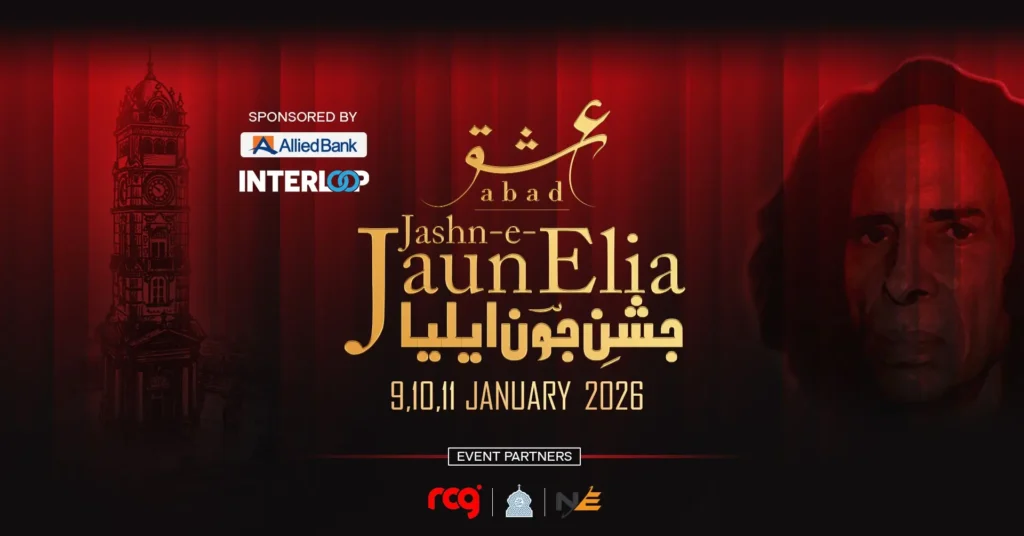
The vibrant city of Faisalabad, transformed for a weekend into the literary sanctuary of Ishqabad, played host to a profound intellectual gathering during the Jashn-e-Jaun Elia festival in early 2026. While the festival primarily resonated with the haunting and defiant verses of Jaun Elia, a special session dedicated to the national economy brought a different kind of intensity to the Nusrat Fateh Ali Khan Auditorium. This session was not merely a dry recitation of fiscal figures; it was a deliberate attempt to view the harsh realities of Pakistan’s financial health through the philosophical and often skeptical lens of Jaun Elia’s world.
The moderator, Nasira, set the stage by introducing a panel that represented the pinnacle of Pakistani banking, bureaucracy, and technical expertise, ensuring that the Jashn-e-Jaun Elia would be remembered as a place where the heart and the ledger met in honest dialogue. She opened the floor with a verse that perfectly encapsulated the mood of questioning and introspection:
عمر گزرے گی امتحان میں کیا
داغ ہی دیں گے مجھ کو دان میں کیا
میری ہر بات بے اثر ہی رہی
نقص ہے کچھ میرے بیان میں کیا
مجھ کو تو کوئی ٹوکتا بھی نہیں
یہی ہوتا ہے خاندان میں کیا؟
Introduction of the Panelists and the Narrative Framework
The session commenced with the introduction of three heavyweights of the Pakistani establishment. Zafar Masud, the President of the Bank of Punjab and Chairman of the Pakistan Banks Association, was welcomed as a figure who bridges the gap between the corporate banking world and the literary circles of Pakistan. Following him, the stage was graced by Fawad Hasan Fawad, a seasoned bureaucrat known for his tenure as Principal Secretary to the Prime Minister and his blunt assessments of state governance.
The trio was completed by Kazim Saeed, an expert in energy and agricultural policy. The moderator emphasized that the Jashn-e-Jaun Elia was the perfect venue for such a talk, as Jaun’s poetry often questioned the structures of society, much like these experts would question the structures of the economy.
Zafar Masud on the Banking Sector and the Leaking Fountainhead
Zafar Masud opened the discussion by addressing a frequent grievance heard in Pakistani households and newsrooms: the perceived reluctance of banks to lend to the private sector. Masud, a central figure in the Jashn-e-Jaun Elia narrative, chose to explain this through a sophisticated analogy. He described the national economy as a system with a “leaking fountainhead.” He argued that while the banking industry is often treated as a “soft target” for criticism, it is actually a symptom of a deeper malaise.
Masud explained that because 52% of Pakistan’s economy contributes only 3.6% to the total tax revenue, the government faces a massive shortfall. To keep the lights on and the state functioning, the government is forced to borrow from the only reliable source of liquidity: the banks. “If the fountainhead is leaking,” Masud noted during the Jashn-e-Jaun Elia talk, “the pond—representing the private sector—will inevitably remain dry.” He challenged the audience to look at the documentation crisis, stating that banks cannot responsibly lend to businesses that refuse to document their finances or pay their share of taxes.
Debunking Myths of Credit Allocation and SME Growth
One of the most powerful moments of Zafar Masud’s contribution to the Jashn-e-Jaun Elia session was his presentation of hard data to counter public perception. He revealed that despite the structural hurdles, the banking industry has made significant strides in sectors that truly matter. He shared that lending to Small and Medium Enterprises (SMEs) has effectively doubled over the last two years.
Furthermore, he highlighted a reversal in the long-term decline of agricultural borrowers, noting that for the first time since 2019, the number of borrowers has grown from 2.7 million to 3 million. Masud emphasized that these aren’t just numbers on a balance sheet; they represent thousands of farmers and small business owners who are finally being integrated into the formal economy. To emphasize the need for personal responsibility in fixing the economy, he quoted a favorite verse of his co-panelist Fawad Hasan Fawad:
شکوہِ ظلمتِ شب سے تو کہیں بہتر تھا
اپنے حصے کی کوئی شمع جلاتے جاتے
See also: Mr. Zafar Masud highlights the SME revival program with Dr. Maria Zulfiqar Khan
Fawad Hasan Fawad on State Governance and the Burden of Public Entities
Following Masud, Fawad Hasan Fawad took a more systemic and critical approach to the discussion at the Jashn-e-Jaun Elia. He argued that the state of Pakistan has overextended itself into businesses it has no expertise in managing. Fawad focused on the massive losses incurred by State-Owned Enterprises (SOEs), specifically mentioning the recurring financial drains like PIA and the power sector.
He argued that the reason banks lend to the government is not out of preference, but out of necessity because the state is perpetually in “emergency mode” due to these losses. For Fawad, the Jashn-e-Jaun Elia was an opportunity to speak truth to power, suggesting that unless the state exits the business of running airlines and steel mills, no amount of banking reform would save the national economy. Describing the repetitive cycles of economic failure, he recited a verse by Jaun Elia:
میں بھی بہت عجیب ہوں، اتنا عجیب ہوں کہ بس
خود کو تباہ کر لیا اور ملال بھی نہیں
Kazim Saeed on Energy Guarantees and Agricultural Viability
Kazim Saeed brought the focus toward the technical “plumbing” of the economy during the Jashn-e-Jaun Elia session. He spoke extensively about the energy sector and the sovereign guarantees provided to Independent Power Producers (IPPs). Saeed explained that the current model is unsustainable because the government guarantees payments regardless of consumption, leading to the circular debt that plagues the nation.
He drew a parallel to the agricultural sector, suggesting that Pakistan needs to move toward a market-driven approach rather than a subsidy-driven one. His contribution to the Jashn-e-Jaun Elia emphasized that structural reform in energy is the prerequisite for industrial growth, as high power tariffs are currently killing the competitive edge of Pakistani exports.
The Structural Disease: Low Investment and Lack of Productivity
As the dialogue deepened, Zafar Masud returned to the podium at the Jashn-e-Jaun Elia to identify what he called the “real structural disease” of Pakistan. He pointed out that the national investment-to-GDP ratio is currently below 13%. When compared to regional competitors like India or Vietnam, where these ratios are nearly double, Pakistan’s lack of capital formation becomes evident.
Masud argued that the problem isn’t just a lack of money, but a lack of productivity. “We have become a nation of rent-seekers,” he remarked during the Jashn-e-Jaun Elia discourse. He criticized the tendency of capital to flow into unproductive sectors like real estate rather than manufacturing or technology.
For Masud, the economic malaise is a reflection of a mindset that avoids risk and innovation, a sentiment he felt mirrored Jaun Elia’s own frustrations with the stagnation of thought in society. To illustrate the stubbornness of decision-makers who refuse to acknowledge the impending crisis, he quoted Rais Amrohvi:
کہنے لگے کہ ہم کو تباہی کا غم نہیں
میں نے کہا وجہِ تباہی یہی تو ہے
ہم لوگ ہیں عذابِ الٰہی سے بے خبر
اے بے خبر عذابِ الٰہی یہی تو ہے
The Deficit of Human Capital and Modern Mindsets
A significant portion of the Jashn-e-Jaun Elia economy session was dedicated to the idea that economic figures are ultimately a result of human resources. Masud stressed that the “major problem” facing the country is a deficit in quality education and health.
He argued that even if the country received a massive influx of cash tomorrow, it would not be able to utilize it effectively without a skilled and healthy workforce. He highlighted the stubbornness of the administrative and political classes, noting that a refusal to change outdated viewpoints is perhaps the biggest barrier to progress.
This theme of intellectual stagnation was a recurring thread throughout the Jashn-e-Jaun Elia, linking the economic panel to the poetic sessions that criticized societal norms.
Poetry as a Mirror to Economic Neglect
True to the spirit of the Jashn-e-Jaun Elia, the panelists used literature to underscore their points. Zafar Masud, in particular, used Jaun Elia’s verses to describe the disconnect between the ruling elite and the suffering of the masses. He noted that while there is constant talk and “hullabaloo” about reform, the actual material conditions of the people remain unchanged.
The poetry served as a sobering reminder that economic failure has a human cost—one that poets like Jaun Elia captured with haunting precision. The audience at the Jashn-e-Jaun Elia was reminded that the “divine disaster” (Azab-e-Ilahi) Jaun wrote about is often self-inflicted through decades of fiscal mismanagement and neglect. To close his remarks on a hopeful yet cautionary note about the country’s economic future, Kazim Saeed recited:
ہیں دلیلیں تیرے خلاف مگر
سوچتا ہوں تیری حمایت میں
A Vision for the Future: Education, Health, and Impact Analysis
In the final moments of the Jashn-e-Jaun Elia economy session, the moderator asked Zafar Masud to summarize his vision for what he had yet to achieve. Masud’s response was focused on social equity. He stated that his primary goal, beyond banking metrics, is to see a radical shift in budget allocations toward education and health.
However, he added a crucial caveat: “We don’t just need more spending; we need impact analysis.” He argued that the Jashn-e-Jaun Elia should inspire a new kind of accountability where the government must prove that every rupee spent on a school or a hospital actually resulted in a better outcome for a child or a patient.
Conclusion: The Legacy of the Jashn-e-Jaun Elia Dialogue
The session concluded with a standing ovation, not just for the speakers’ expertise, but for their willingness to be honest in a public forum. The Jashn-e-Jaun Elia proved that economic policy is not a subject that should be confined to closed boardrooms; it is a vital part of the national conversation that belongs in the public square. By combining the data-driven insights of Zafar Masud with the systemic critiques of Fawad Hasan Fawad and the technical knowledge of Kazim Saeed, the Jashn-e-Jaun Elia provided a holistic view of the challenges ahead.
It left the audience with a sense that while the “tangled” state of the economy is daunting, it can only be “solved” through the kind of fearless questioning and intellectual honesty that Jaun Elia championed throughout his life. As the lights dimmed on the Jashn-e-Jaun Elia, the message was clear: the time for borrowing time has ended, and the era of structural accountability must begin.
Jashn-e-Jaun Elia: A Global Celebration of the Uncrowned King of Urdu Poetry
The legacy of Syed Hussain Sibt-e-Asghar Naqvi, universally known by his pen name Jaun Elia, has undergone a remarkable transformation in the decades following his death. Once a figure of niche intellectual fascination and a staple of the Karachi coffee-house circuit, Elia has evolved into a global cultural icon for the youth.1 The “Jashn-e-Jaun Elia” (Celebration of Jaun Elia) has become the premier vehicle for this revival, morphing from small commemorative gatherings into massive, multi-day international festivals that blend high literature with modern cultural discourse.
The 2026 Milestone: Faisalabad as “Ishqabad”
The Jashn-e-Jaun Elia 2026, held from January 9th to 11th at the Nusrat Fateh Ali Khan Auditorium (Faisalabad Arts Council), marked a historic high point for the festival. Organized by the Punjab Council of the Arts in collaboration with the renowned poet Abbas Tabish, the event famously rebranded the industrial city of Faisalabad as “Ishqabad” (The City of Love) for the duration of the celebrations.
This year’s event was characterized by an unprecedented scale of public participation, particularly from university students and the younger generation. The festival was not merely a series of poetry recitals but a holistic cultural experience.
Key Sessions and Highlights of 2026
The “Economy and Literature” Session:
In a unique departure from traditional literary festivals, the 2026 event featured a deep-dive session on Pakistan’s economic future, moderated by Nasra. High-profile speakers included Zafar Masud (President of Bank of Punjab), Fawad Hasan Fawad (Former Principal Secretary), and Kazim Saeed.
Zafar Masud notably used the platform to bridge the gap between finance and philosophy. He introduced his “Leaking Fountainhead” analogy to explain the national deficit and cited the defiant verses of Jaun Elia and Rais Amrohvi to highlight administrative stubbornness. He argued that the real structural disease of Pakistan is a lack of investment in human capital—education and health—which he framed as a “divine disaster” (Azab-e-Ilahi) if left unaddressed.
The Grand International Mushaira:
The heart of the festival remained the Mushaira. The 2026 stage saw a convergence of classical masters and contemporary stars. Figures like Iftikhar Arif, Abbas Tabish, and Hammad Ghaznavi recited their latest works, while legendary actor Munawar Saeed provided dramatic readings of Jaun’s most famous ghazals, bringing his idiosyncratic style—characterized by self-loathing, nihilism, and raw honesty—back to life.
Intellectual Discourse and Book Launches:
The festival served as a launchpad for several academic inquiries into Jaun’s work. Discussions focused on Jaun’s prose—often overshadowed by his poetry—specifically his philosophical essays and his mastery of the Arabic, Persian, and Hebrew languages. Scholars debated the “Jaun Phenomenon” on social media, analyzing how a poet who died in 2002 became the most quoted figure on Instagram and TikTok in the mid-2020s.
Evolution from Past Jashn-e-Jaun Elia Events
The Jashn-e-Jaun Elia has grown exponentially since its inception. To understand the 2026 success, one must look at the foundation laid in previous years:
- The Early Commemorations: Initially, the “Jashn” started as localized events in Karachi and Dubai, organized by close associates like Khalid Ahmed and the Jaun Elia Academy. These were intimate affairs focused on preserving his unpublished manuscripts.
- The Digital Shift (2015-2020): As Jaun’s videos began to go viral on YouTube, the Jashn expanded to Lahore and Islamabad. This era saw the festival becoming a “must-attend” for the literati, with crowds growing from hundreds to thousands.
- The 2024-2025 Expansion: By 2025, the festival began incorporating broader themes of “Humanizing Economics” and “Art for Social Change,” led by figures like Zafar Masud who saw Jaun’s work as a catalyst for questioning the status quo. The Faisalabad 2026 event was the culmination of this trend, turning a literary tribute into a national intellectual movement.
Why Jaun Elia? The Enduring Appeal
At every Jashn-e-Jaun Elia, the central question is: why does he resonate so deeply today? The 2026 festival answered this through its diverse programming. Jaun’s poetry is the poetry of “un-belonging.” In an era of global displacement and digital superficiality, his lines about loneliness, the failure of romance, and the hypocrisy of the elite feel contemporary.2
As Divisional Commissioner Raja Jahangir Anwar noted during the 2026 closing ceremony, the festival succeeded because it didn’t just look backward; it used Jaun’s rebellious spirit to look forward at Pakistan’s social and economic challenges.
Conclusion
The Jashn-e-Jaun Elia 2026 has set a new benchmark for how literary legacies can be celebrated. By moving beyond the “ivory tower” of poetry and engaging with the real-world anxieties of the youth—from banking to bureaucracy—the festival ensures that Jaun Elia remains not just a poet of the past, but a philosopher for the future. The transformation of Faisalabad into “Ishqabad” stands as a testament to the power of words to reshape the identity of a city and its people.