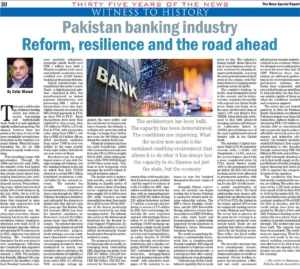
In this article “Pakistan Banking Industry”, the author Mr. Zafar Masud explains how privatization, Islamic banking and the transformative Raast digital gateway have completely reshaped Pakistan’s banking industry over the last 35 years. Explore how the sector achieved a record $38.3 billion in remittances and a 21.4% Capital Adequacy Ratio while navigating high tax rates and economic shifts.
Pakistan Banking Industry Article Summary
The article outlines the 35-year evolution of Pakistan’s banking sector from a state-directed, loss-making industry into a well-capitalized, digitally advanced, and highly resilient financial pillar. This dramatic shift began with the privatization of major state-owned commercial banks in the 1990s and early 2000s, which successfully lowered non-performing loans from nearly 26% to 8.3% by 2005.
A prominent catalyst for modern growth has been the organic revolution of Islamic banking. Holding 25.1% of total industry deposits and experiencing a 30.7% year-on-year asset growth in 2025, Islamic financial institutions are aggressively scaling to meet the constitutional mandate of eliminating riba (interest) before January 1, 2028. This transition is backed by a high-level Steering Committee, over PKR 4 trillion in sovereign sukuk, and 25,000 certified professionals.
Concurrently, digital infrastructure has revolutionized financial accessibility. The instant payment gateway, Raast, launched in 2021, currently processes PKR 1 trillion every nine days. Digital channels accounted for 88% of retail payments in FY25, driving active Raast users to 48 million and scaling QR-enabled merchants past one million. Consequently, general financial inclusion surged from 13% in 2014 to 64% by 2025. Gender-focused policies also bridged massive gaps: women’s account ownership expanded from under 5% to over 47%, while women’s sector employment topped 20%. The industry also serves as the operational backbone for the Benazir Income Support Programme (BISP), facilitating biometrically verified cash transfers to over 9 million beneficiaries.
Furthermore, the banking sector serves as the primary conduit for critical foreign exchange. In FY25, workers’ remittances hit a record $38.3 billion, with the Roshan Digital Account (RDA) drawing over $12 billion across 900,000 accounts. Priority sectors have also observed notable growth: outstanding SME financing nearly doubled to PKR 882 billion by December 2025, while agricultural credit reached PKR 981 billion. Massive interest-free, mortgage-based initiatives are aiming to secure 350,000 low-cost houses by June 2027. Additionally, the sector has embraced environmental stewardship, injecting over PKR 150 billion into renewable energy under the State Bank of Pakistan’s (SBP) Green Banking Guidelines.
Despite these triumphs, structural and fiscal challenges persist. While the industry boasts a robust Capital Adequacy Ratio of 21.4%—outperforming regional peers like India and Bangladesh—it remains heavily entangled with state debt. By 2025, 62% of banking assets were tied up in government securities, crowding out private sector lending to just 22%. Compounding this, banks faced an effective tax rate of 54.1% in FY25, the highest in the region.
Rather than remaining passive, banks have actively supported macroeconomic stabilization, restructuring PKR 1.225 trillion in circular debt and PKR 268 billion in PIA debt. With the policy rate falling from 22% to 10.5% by December 2025, a primary fiscal surplus of 3%, and upgraded sovereign credit ratings, Pakistan’s banking sector stands in a position of genuine institutional strength, poised to fully transition from financing the state to driving the broader economy.
Pakistan Banking Industry
By Zafar Masud. Published in The News International on May 22, 2026
Three and a half decades ago, Pakistan’s banking sector was state-directed, loss-making and institutionally weak. Today it is well-capitalised, digitally enabled and growing. The distance between those two points is the story of one of the more remarkable sectoral transformations in the country’s economic history. What that transformation has not yet fully delivered is equally worth examining.
That rebuilding began with privatisation. Through the 1990s and into the early 2000s, the transfer of the four largest state-owned commercial banks into private hands turned loss-making institutions into profitable, tax-paying pillars of the financial system. Non-performing loans, which had reached nearly 26% of total advances by the late 1990s, fell to 8.3% by 2005. The contrast with institutions that remained in state hands only underscores how decisive that shift was.
See also: ‘IMF, privatisation not a solution’
If privatisation was the structural correction, Islamic banking has been the organic revolution. Islamic banking institutions now hold 25.1% of total industry deposits, with assets growing 30.7% year-on-year in 2025, outpacing conventional banking. The constitutional foundation for the next phase is now unambiguous: following the Constitution that stipulates the elimination of riba before January 1, 2028. The industry has formally affirmed full commitment to the deadline; a high-level Steering Committee oversees quarterly milestones; sovereign sukuk worth over PKR 4 trillion have built a Shariah-compliant yield curve; and industry academies have certified over 25,000 Islamic banking professionals hitherto.
See also: Mr. Zafar Masud on Shifting to Islamic Banking
Digital infrastructure has transformed the sector’s reach. Raast – a digital payment gateway – launched in 2021, was transformational, an instant payment infrastructure now processing PKR 1 trillion in transactions every nine days. Digital channels accounted for 88% of retail payments in FY25, up from 76% in FY23. Raast transactions grew more than eightfold in three years, from 147 million in FY23 to 1,276 million in FY25, with transaction value rising from PKR 3.1 trillion to PKR 44.3 trillion. QR-enabled merchants expanded from under 7,000 to over one million in the same period. Forty-eight million individuals are now active on Raast.
Remittances are the single largest source of non-debt foreign exchange for Pakistan, and the banking industry is the rail on which they flow. FY2025 closed at a record $38.3 billion in workers’ remittances, a critical buffer for the external account. The industry has steadily compressed turnaround times, reduced corridor costs through the SBP-led Pakistan Remittance Initiative, and onboarded the diaspora to digital rails that did not exist five years ago.
The Roshan Digital Account (RDA) has been the standout: cumulative inflows have crossed $12 billion across more than 900,000 accounts. The product has been continuously enhanced and full mobile self-service – progressively turning a one-way remittance channel into a two-way financial engagement platform, encouraging investment driven remittances to merely consumption driven and hence the recent inclusion of eligibility of foreign nationals and institutions under RDA 2.0 offering. With sovereign ratings upgraded, the rupee stable, and the crackdown on illegal remittance channels, the industry is well-placed to grow this critical foreign exchange flow further and cross the $40 billion mark during the current fiscal year.
Financial inclusion has been the quiet beneficiary. Adults with a transaction account rose from just 13% in 2014 to roughly 64% by 2025, within striking distance of the NFIS 2023-28 target of 65% three years early. Pakistan is now frequently cited amongst the world’s fastest financial inclusion gainers.
The gender story is particularly notable: under the SBP’s Banking on Equality policy of 2021, women’s share of banking sector employment has risen from roughly 12% in 2018 to over 20%, while women’s account ownership has risen from under 5% in 2014 to over 47% by 2025 – one of the fastest gender-gap closures recorded by any large emerging market. The industry also serves as the disbursement backbone for the Benazir Income Support Programme, delivering cash transfers to over 9 million predominantly female beneficiaries through biometric-enabled accounts.
The progress in priority sector financing tells an equally encouraging story. Outstanding SME financing has grown from PKR 457 billion (154,229 borrowers) at the FY23 trough to PKR 882 billion (302,922 borrowers) by December 2025 – outstanding credit nearly doubled, borrowers nearly doubled – and the target it to enhance it to Rs.1.5 trillion by 2028. Agriculture credit has moved in tandem, with an outstanding portfolio of PKR 981 billion serving 2.95 million borrowers up from 2.7 million a year ago and targeting in excess of 3.5 million by 2028.
Low-cost housing, historically the most neglected segment with mortgage finance below 1% of GDP, has turned startling: 18,000 mortgage approvals in a single recent month under the Punjab Chief Minister’s low-cost housing initiative, an earlier tranche of 133,000 houses through microfinance institutions, and a pipeline targeting 350,000 houses by June 2027 – ostensibly the “largest interest-free, mortgage-based low-cost housing scheme in the world” – with cumulative mortgages of the industry to enhance to over five hundred thousand in the next couple of years.
Alongside Islamic conversion, the industry has begun lending like it knows Pakistan is among the world’s most climate-vulnerable nations. The SBP’s Green Banking Guidelines, and the 2023 Renewable Energy refinance scheme have channelled over PKR 150 billion into solar, wind, hydro and biomass projects. A particularly important recent milestone is Pakistan’s Green Taxonomy test phase launch.
The result is something distinctive: a sustainability framework that is simultaneously Shariah-compliant, ESG-aligned and tailored to Pakistan’s social priorities to alleviate poverty – a convergence few other emerging markets are even attempting.
Underpinning all this is institutional capability that is rarely given its due. The industry’s human capital – drawn from the top of every business school cohort, anchored by returning diaspora professionals – is among the most professionalised talent pools in the country, with Pakistani bankers occupying senior positions across the globe.
The country’s banking, by far the most transparent sector in the country, and its infrastructure compares favourably with regional and Global South peers: Raast and 1Link, sit in the same architectural class as India’s UPI and Brazil’s Pix; PRISM+ bring wholesale settlement in line with advanced emerging markets with biometric verification linked to NADRA gives Pakistan one of the most sophisticated national identity rails in the Global South.
The industry’s Capital Adequacy Ratio of 21.4% materially exceeds India (~16.8%) and Bangladesh (~11.6%), and yet, the sector’s balance sheet tells a more complicated story. In FY24, banks funded nearly 100% of the government’s budget deficit. By 2025, 62% of total banking assets were allocated to government securities, with private sector lending accounting for just 22% of total assets – a partial manifestation of crowding-out effect.
The fiscal relationship runs deeper still. Banks bore an effective tax rate of 54.1% in FY25, the highest in the region, against 30% or less for comparable banking sectors in India, Malaysia and Vietnam. The sector that is asked to do the most for the economy is simultaneously among the most heavily taxed. These are not numbers that reflect a strategic choice by the banking sector. They reflect the fiscal reality the sector has had to accommodate.
The incentive structure has been unambiguous. Government securities offer risk-free returns and require no credit assessment. Private lending requires documentation, collateral and credit assessment infrastructure remains underdeveloped in an economy where the informal sector estimated to account for more than half of GDP. Wherever these constraints are addressed, particularly in the recent times in some government schemes, the banks have responded, and proved that banks are unwilling to lend privately, but that they are entirely capable of doing so when the conditions demand and ecosystem supports.
The sector has not waited passively. In 2025, the Pakistan Banks’ Association coordinated Pakistan’s largest ever financial transaction, eighteen banks restructuring PKR 1.225 trillion in circular debt at concessional rates to pave the way to achieve affordable electricity prices for masses and industries ultimately. The industry similarly enabled Pakistan’s first major privatisation in two decades through restructuring PKR 268 billion in PIA debt, and in February 2026 voluntarily absorbed a cut in their profit margin on Export Refinance Facility, bringing export financing rate down to 4.5% to improve the competitiveness of our exporters.
The conditions that have historically constrained the sector, are shifting. The policy rate was cut by 1,150 basis points from a peak of 22% in June 2023 to 10.5% by December 2025. Fiscal consolidation has produced a primary surplus of 3% of GDP, the first in decades, and the credit ratings have been upgraded by Moody’s, Fitch and S&P, Pakistan’s banking sector enters this next phase from a position of genuine institutional strength. The architecture has been built. The capacity has been demonstrated. The conditions are improving. What the sector now needs is the sustained enabling environment that allows it to do what it has always had the capacity to do: finance not just the state, but the economy.
—The writer is Chairman, Pakistan Banks Association