
Bank of Punjab under Zafar Masud’s Leadership: A Deep Dive into the 2026 Financial Horizon
In this professional “Owner’s Analysis,” financial expert Abdul Rehman Najam dissects the extraordinary evolution of The Bank of Punjab under Zafar Masud’s leadership. BOP has not only weathered industry challenges but has emerged as a leader in structural transformation within the Pakistani banking sector.
This video moves beyond basic metrics to explain why BOP’s recent shift toward a higher Current Account ratio is a “profit engine” that will redefine its valuation by 2026. From the regulatory relief provided by the removal of the Minimum Deposit Rate (MDR) to the implementation of a more frequent dividend policy, this analysis provides a roadmap for what lies ahead for the bank and its stakeholders.
Key Insights Covered:
- The Power of Low-Cost Deposits: Why growing Current Accounts is the ultimate competitive advantage.
- Management Execution: A look at how Bank of Punjab under Zafar Masud’s Leadership achieved a top-tier turnaround.
- Regulatory Catalysts: How the SBP’s policy changes in January 2025 directly benefit BOP’s bottom line.
- Future Valuation: Detailed projections for BOP Performance Analysis 2026, including EPS and fair value targets.
Watch this video above or read the full analysis below to understand the fundamental shift positioning The Bank of Punjab as a cornerstone of growth in the national financial landscape.
Disclaimer: The analysis and views expressed in this video are solely those of the content creator, Abdul Rehman Najam, and ARN Financial Advisors. The republication of this content by Zafar Masud is for informational purposes only and does not constitute an endorsement, recommendation, or sponsorship of the analyst, his company, or any services they offer. Zafar Masud and The Bank of Punjab assume no responsibility for the accuracy of the information provided nor for any investment decisions made based on this content. Viewers are strongly advised to conduct their own due diligence before engaging with any financial service provider.
Video Summary
The Turnaround Engine
The video features an in-depth analysis of The Bank of Punjab (BOP), which host Abdul Rehman Najam identifies as one of the fastest turnarounds in Pakistan’s banking history. He credits this success to the strategic direction of the Bank of Punjab under Zafar Masud’s Leadership. A primary focus is the “Current Account” mix. Najam explains that while savings accounts cost the bank significantly in interest, current accounts provide “free money” that can be lent out at much higher spreads. BOP has aggressively grown its current accounts to nearly 400 Billion PKR, aiming for a 30% ratio to permanently boost its Return on Invested Capital (ROIC).
Regulatory Tailwinds and 2026 Projections
A critical segment discusses the removal of the Minimum Deposit Rate (MDR) by the State Bank of Pakistan in early 2025. This allows banks to repriced their liabilities more efficiently, significantly widening Net Interest Margins. The BOP Performance Analysis 2026 estimates that with a projected deposit base of 2.3 to 2.4 Trillion PKR, the bank could achieve a Profit After Tax of roughly 20 Billion PKR. This would translate into an Earnings Per Share (EPS) of 6.0 to 6.5 PKR, signaling a massive leap in profitability compared to previous cycles.
Valuation and Shareholder Value
he analysis concludes with a valuation model, suggesting that if BOP trades at a conservative Price-to-Earnings (PE) multiple of 7x-8x, its fair value could reach 45-50 PKR per share by 2026. Najam also highlights a major shift in dividend policy—BOP has amended its charter to allow for quarterly or semi-annual payouts, making it more attractive for income-focused investors. He emphasizes that this is the result of a cleaner balance sheet and disciplined management, urging viewers to analyze businesses with an “owner’s mindset.”
Bank of Punjab under Zafar Masud’s Leadership: An Owner’s Analysis of the 2026 Horizon
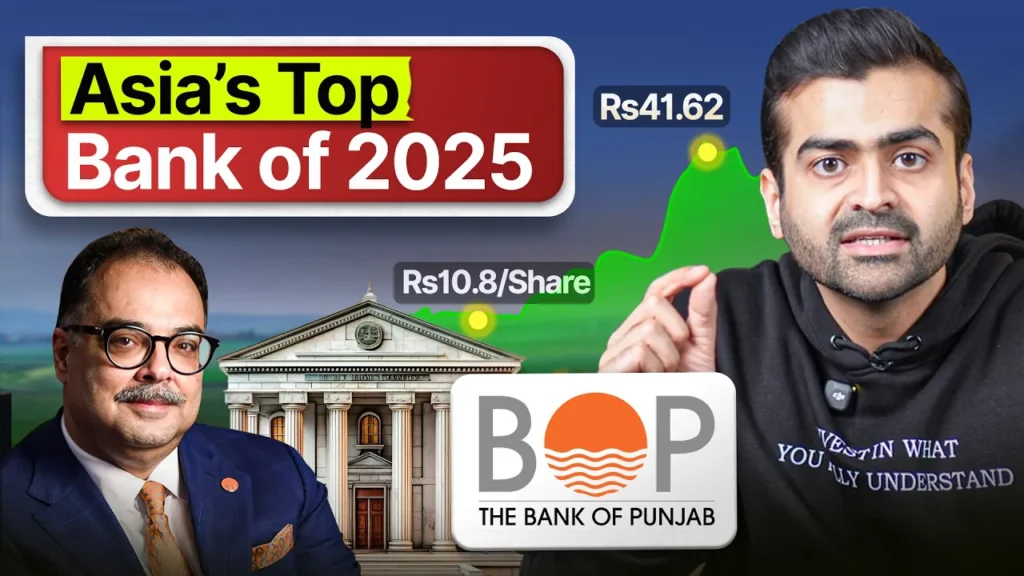
The Strategic Renaissance of The Bank of Punjab
In the landscape of the Pakistan Banking Sector Transformation, few stories are as compelling as the recent resurgence of The Bank of Punjab (BOP). While the broader industry has benefited from high interest rates, BOP has distinguished itself through a transformation that is both structurally profound and rapidly executed. This analysis, inspired by the deep-dive financial breakdown by Abdul Rehman Najam, explores the mechanics behind this turnaround and the comprehensive BOP Performance Analysis 2026.
The Genesis of the Turnaround
The banking sector is often viewed as a monolith, but management execution creates the real divergence. In 2025, The Bank of Punjab emerged as a leader among government-owned banks, securing top rankings for performance. This shift was a direct result of the Bank of Punjab under Zafar Masud’s Leadership. Zafar Masud, a seasoned banker and a survivor of a major plane crash, has instilled a culture of resilience and “owner-oriented” thinking. Under his guidance, the bank moved from a traditional public sector entity to an agile, metric-driven institution focusing on long-term Value Investing in Pakistan Stock Exchange (PSX) principles.
The Financial Engine: Understanding Current Accounts
To appreciate the BOP Performance Analysis 2026, one must understand the “raw material” of banking: Deposits. Abdul Rehman Najam highlights that the profit lies in the “spread”—the difference between the interest earned on loans and the interest paid to depositors.
The BOP Current Account Growth Strategy has been central to this. Current accounts represent “free money” for a bank because they carry 0% interest cost. Historically, BOP relied heavily on savings accounts, which required high payouts. However, the management has successfully grown the current account portfolio to nearly 400 Billion PKR, aiming to increase the Current Account to Deposit ratio to 30%. This shift acts as a structural improvement in the bank’s Return on Invested Capital (ROIC), creating a permanent competitive advantage.
The MDR Game Changer and Regulatory Catalysts
A significant tailwind is the Minimum Deposit Rate (MDR) Impact 2025. In January 2025, the State Bank of Pakistan removed the mandatory floor on what banks had to pay savings account holders. Previously, banks were forced to pay a rate tied closely to the Repo Rate, which squeezed margins when lending yields fell. With the removal of the MDR, Bank of Punjab under Zafar Masud’s Leadership can now negotiate lower rates on deposits, immediately widening Net Interest Margins (NIMs) and boosting overall profitability.
BOP Performance Analysis 2026: The Numbers
Based on the trajectory set by the management, the BOP Performance Analysis 2026 presents a powerful case for value.
- Deposit Growth: Management has guided for a base of 2.3 to 2.4 Trillion PKR by 2026.
- Net Interest Income (NII): With a 25% current account mix, NII is projected to reach ~85 Billion PKR.
- The Bottom Line: After accounting for controlled operating expenses and non-interest income, the bank’s BOP Earnings Per Share (EPS) Forecast sits at an impressive 6.00 to 6.50 PKR.
Valuation: Identifying the Bank of Punjab Fair Value 2026
How should the market price this performance? Pakistani banks typically trade at PE multiples of 8x to 9x during stable periods. Given the structural improvements and cleaner balance sheet, a conservative PE of 7x to 8x is justifiable. This places the Bank of Punjab Fair Value 2026 in the range of 45 to 50 PKR per share, representing significant upside for investors who recognize the turnaround early.
The Dividend Evolution
For income-focused investors, a critical governance change has occurred. Historically, BOP was restricted to annual dividend payouts. Under current management, the bank has amended its charter to allow for quarterly or semi-annual dividends. This move aligns BOP with top-tier private banks and provides a regular income stream, with expected payouts of 3.50 to 4.00 PKR per share by 2026.
Conclusion: The Owner’s Perspective
The transformation of The Bank of Punjab is a masterclass in operational efficiency. By fixing the deposit mix and leveraging regulatory relief, the Bank of Punjab under Zafar Masud’s Leadership has rebuilt its foundation. As Abdul Rehman Najam emphasizes, investing requires an “owner’s mindset.” For BOP, that mindset has turned a lethargic lender into a competitive, deposit-rich financial powerhouse.
See also: Managing External Account – Structural Changes (3 of 3)
About the Host: Abdul Rehman Najam
Abdul Rehman Najam is a prominent Pakistani value investor, financial analyst, and the Founder & CEO of ARN Financial Advisors. With a background in Economics from the University of Warwick, he has dedicated his career to improving financial literacy and helping individuals navigate the complexities of the Pakistan Stock Exchange.
Known for his “Owner’s Analysis” framework, Abdul Rehman focuses on fundamental business models rather than speculative trading. His philosophy is deeply rooted in the principles of Warren Buffett—buying quality businesses at a discount and holding them for long-term compounding. He is widely recognized for his ability to simplify complex macroeconomic indicators, such as interest rate cycles and regulatory shifts, making them accessible to retail investors.
His YouTube channel, @AbdulRehmanNajamofficial, has grown into a leading platform for financial education in Pakistan, boasting nearly 100,000 subscribers. Through his videos, he provides deep-dives into various sectors, from banking to textiles, teaching his audience how to analyze balance sheets and project future earnings. Abdul Rehman is also a frequent speaker at TEDx events and top-tier podcasts, where he advocates for a “Rich Mindset” and the importance of financial independence.
ARN Financial Advisors Private Limited
ARN Financial Advisors is a premier SECP-certified investment advisory firm based in Lahore, Pakistan. The company manages a portfolio exceeding 5 Billion PKR for its members, providing research-backed guidance on equity markets and wealth management.
The firm operates on a unique “Investor-First” model. They provide tailored advisory services without taking custody of client funds, ensuring that the client remains the ultimate decision-maker. Their core offerings include:
- Financial Advisory: One-to-one consulting for high-net-worth individuals and corporate entities.
- Investing Masterclass: A comprehensive training program (now in its 5th batch) that teaches students how to use the “ARN Investing Framework” to identify undervalued stocks.
- Market Research: Regular deep-dives into sectoral performance and macroeconomic trends.
Under the “ARN Philosophy,” the firm emphasizes Mindset, Owner’s Insight, and Value Realization. Their mission is to foster a “Financial Freedom Movement” in Pakistan by empowering investors with the tools to grow their savings responsibly.
Important Notice: By reproducing this market analysis, Zafar Masud does not endorse, recommend, or vouch for the services, products, or professional standing of Abdul Rehman Najam or ARN Financial Advisors. This content is shared strictly as an independent market perspective. Zafar Masud, BOP and all his associated organisations expressly disclaims any liability for losses or damages resulting from the use of the analyst’s services or reliance on their advice. No formal partnership or affiliation exists between the parties.