
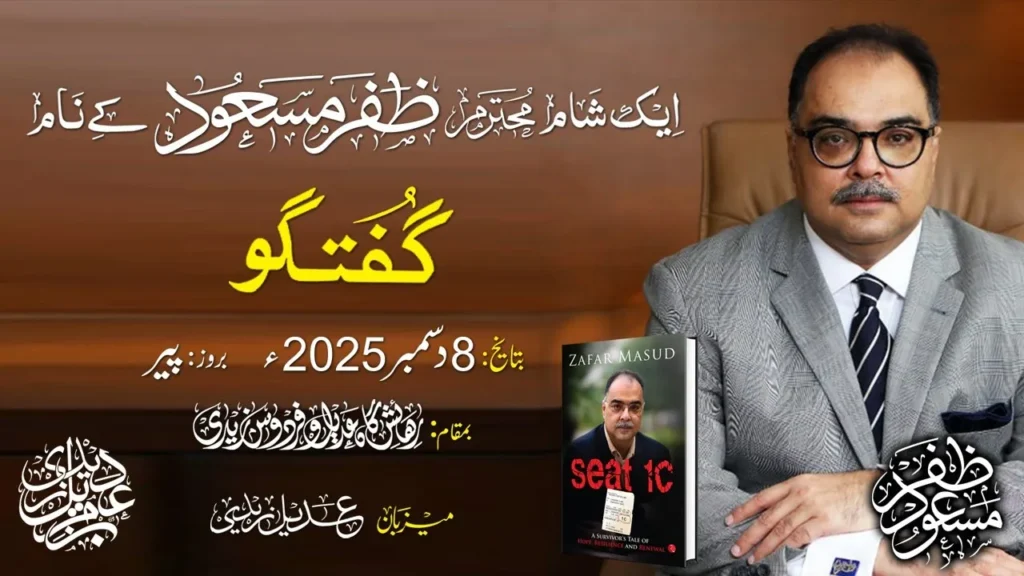
In this significant episode of Guftugoo, Zafar Masud joins host Adeel Zaidi for a conversation that goes well beyond the professional sphere. Recorded in December 2025, this session marks a special milestone as the very first face-to-face meeting between Mr. Masud and the host.
The dialogue was held in the intimate and welcoming environment of the residence of Firdous and Adeel Zaidi. Throughout the session, the discussion explores the profound journey of the “Seat 1C” survivor, offering a unique look into the personal philosophies and leadership principles that guide Mr. Masud today.
The conversation is further enriched by the presence of Fawad Hassan Fawad, whose collaborative insights add a layer of depth to the themes of resilience and life lessons discussed.
Zafar Masud’s ‘Guftugoo’ with Adeel Zaidi
Introduction
In the annals of aviation history, few stories are as harrowing and miraculous as that of Pakistan International Airlines Flight 8303. On May 22, 2020, the Airbus A320 crashed into a densely populated neighborhood in Karachi, claiming the lives of 97 passengers and crew. Amidst the devastation, two individuals emerged alive. One of them was Zafar Masud, the President and CEO of the Bank of Punjab.
Read more: Real Story of a Plane Crash Survivor
In a profound and recent session of Guftugoo with Adeel Zaidi and Fawad Hassan Fawad, Zafar Masud opened up about his journey—not just of surviving a catastrophe, but of the philosophical and spiritual transformation that followed. Titled “Reflections on Resilience,” this conversation delves deep into the psyche of a man who looked death in the face and returned with a renewed sense of purpose. This article explores the key themes of that dialogue, Masud’s memoir Seat 1C, and the lessons on leadership, humility, and faith that he now shares with the world.
The Miracle of Seat 1C
The title of Zafar Masud’s memoir, Seat 1C, serves as a chilling anchor for his story. On that fateful day, a series of seemingly mundane decisions led him to that specific seat—a choice that likely saved his life. As the aircraft lost its engines and plummeted into the Model Colony, the fuselage broke in such a way that Masud, still strapped into his seat, was ejected from the burning wreckage.
In the interview, Masud reflects on this moment not with a sense of ego, but with deep humility. He recalls the terrifying proximity of death, noting that few people have seen the end so close and lived to tell the tale. “Maut ko itne qareeb se dekha hai” (I have seen death so closely), he remarks, suggesting that such an experience fundamentally alters one’s “DNA”—not biologically, but psychologically. It shifts the “frame of mind” entirely.
Refining the Concept of Resilience
One of the most striking segments of the Guftugoo session is Masud’s deconstruction of “resilience.” Often, survivors are painted as heroes or “chosen ones,” implying a divine indispensability. Masud vehemently rejects this notion.
The Fallacy of Indispensability
Masud shares a powerful realization he had post-crash: “I do not want to fall into the frame of mind that I am so important that God saved me because no one else could do my job.” He candidly admits that if he were gone, the Bank of Punjab would still run, perhaps even better; the Pakistan Banks Association would find new leadership; and the organizations he heads would continue. This admission is not self-deprecation but a spiritual liberation. By releasing the burden of being “essential,” he opens himself up to the true responsibility of survival: to be of service in ways that transcend professional titles.
Resilience as a “Frame of Mind”
He argues that resilience is less about an inherent trait and more about one’s environment and mindset. He credits the influence of his family, friends, and the intellectual legacy he inherited. He mentions the “50 books” worth of stories and wisdom passed down through his lineage—referencing his cousin Kazim, his sister Sumaira, and elders like his Phupha and Taya. This community of support, he suggests, builds the mental infrastructure required to bounce back from trauma.
The Book: Seat 1C and Systemic Reflection
Masud’s survival led to the writing of Seat 1C: A Survivor’s Tale of Hope, Resilience, and Renewal. The book is described not merely as a memoir of a crash but as a critique of the systems that allowed it to happen.
A Critique of Complacency
Masud uses his platform to highlight the “arrogance and complacency” within institutions. The crash of PK8303 was not an isolated incident but a symptom of deeper systemic rot—failures in governance, disregard for protocols, and a culture that often prioritizes image over safety.
The “Resilience of Ordinary People”
A recurring theme in Masud’s reflections is the contrast between institutional failure and individual heroism. He often recounts how he was pulled from the debris not by official rescue teams initially, but by the brave residents of the colony—ordinary people who rushed into the fire to save a stranger. This “fundamental decency” of the common man is what Masud believes truly defines the resilience of Pakistan.
Guftugoo: A Conversation Among Friends
The dynamic of the interview adds a layer of warmth to the heavy subject matter. Moderated by Adeel Zaidi, the presence of Fawad Hassan Fawad—a close friend and intellectual peer—allows for a candid exchange. Fawad praises Masud’s ability to remain engaged and attentive despite his grueling schedule, noting that Masud had flown in specifically for this talk, squeezing it between late-night conference calls.
They joke about the “distractions” during the event, with Masud humorously pointing out how Adeel Zaidi kept signaling to the camera crew. This lightheartedness serves as a testament to Masud’s recovery; he is not a man broken by trauma, but one who can find joy and humor in the company of friends, even while discussing the darkest day of his life.
Conclusion: The Duty of the Survivor
Zafar Masud’s journey from the wreckage of PK8303 to the stage of Guftugoo is a powerful narrative of second chances. He does not view his survival as a badge of honor but as a “duty.” It is a duty to speak the truth about systemic failures, to lead with empathy, and to remind us all of our fragility.
As he eloquently puts it, the goal is not to believe one is special, but to become “bekaar” (selfless/void of ego) in the hands of the Divine—to serve without the arrogance of thinking the world cannot spin without us. In a world often obsessed with self-importance, Zafar Masud’s reflections from Seat 1C offer a refreshing and necessary lesson in humility and grace.
Key Takeaways from the Interview:
- Survival is not a merit: Being saved does not mean you are better than those who were lost; it simply means you have a remaining purpose.
- Professional dispensability: Institutions are larger than individuals. True legacy is not in holding a position but in how you impact others.
- The power of community: Resilience is built through the “influence” of family, friends, and shared stories.
- Gratitude for the ordinary: The real heroes are often the ordinary citizens who step up when systems fail.
The Zaidi Channel: A Digital Sanctuary for Urdu Literature and Culture

In an era dominated by fleeting viral clips and fast-paced vlogs, the Zaidi Channel stands out as a dedicated repository of culture, intellect, and refined conversation. Operating under the YouTube handle @zaidichannel, this platform has carved a unique niche for itself, serving as a bridge between the Urdu-speaking diaspora and the rich literary heritage of South Asia.
Based primarily out of the United States (specifically the Houston and Sugar Land, Texas area), the channel is more than just a collection of videos; it is a digital archive of contemporary Urdu history, capturing the voices of poets, writers, bureaucrats, and thinkers who shape the intellectual landscape of Pakistan and beyond.
The Architect: Adeel Zaidi
At the heart of the Zaidi Channel is its owner and primary host, Adeel Zaidi. Far from being a passive observer, Adeel Zaidi is a deeply embedded figure in the literary world. He is a poet in his own right, known for his collection of poetry titled Qarz-e-Ja’n. His deep understanding of the nuances of Urdu language and adab (etiquette) allows him to navigate conversations with literary giants on equal footing.
Adeel serves as the moderator, interviewer, and curator of the channel’s content. His hosting style is characterized by a “Guftugoo” (conversation) approach—gentle, respectful, yet intellectually rigorous. Unlike sensationalist talk show hosts, Adeel focuses on giving his guests space to articulate complex thoughts, often guiding the discussion toward philosophy, resilience, and the human condition.
Supporting him in these endeavors is Firdous Zaidi (often cited as a co-host for events held at their residence), playing a pivotal role in the hospitality and organization that defines the channel’s signature events.
The Nature of Videos and Content Ecosystem
The content on Zaidi Channel is meticulously curated, catering to an audience that values Tehzeeb (culture) and Adab (literature). The videos generally fall into several distinct categories:
The Guftugoo (Conversation) Series
This is arguably the channel’s flagship segment. In these sit-down sessions, Adeel Zaidi engages with prominent figures in intimate, often living-room settings. These are not soundbite-driven interviews but hour-long deep dives into the guests’ lives and philosophies.
- Notable Guests: The channel has featured heavyweights such as Zafar Masud (President of the Bank of Punjab and crash survivor), Fawad Hassan Fawad (former civil servant and poet), and various visiting scholars.
- Themes: Discussions range from personal resilience and survival stories to the intricacies of bureaucracy, governance, and the role of literature in society.
Bazm-e-Adeel Zaidi and Literary Gatherings
A significant portion of the channel’s content documents literary gatherings (Mushairas) hosted by the Zaidis. These events, often titled Bazm-e-Adeel Zaidi, serve as a platform for visiting poets from Pakistan and India to recite their work to an appreciative diaspora audience.
- Poetic Giants: The channel hosts recitals and talks by legendary figures such as Abbas Tabish, Sarmad Sehbai, Iftikhar Arif, and Amjad Islam Amjad.
- Format: These videos capture the atmosphere of a traditional Mushaira, complete with the audience’s “wah-wah” (praise) and the poet’s commentary on their own verses.
Book Launches and Tributes
The channel acts as a launchpad for new literary works. Videos often feature the unveiling of new books, accompanied by critical analysis and speeches by peers. Additionally, the channel produces tribute content, such as documentaries or compilations dedicated to icons like Jaun Elia, preserving their legacy for a digital generation.
Cultural Documentation
Beyond literature, the channel documents the broader cultural activities of the Pakistani-American community in Houston. This includes coverage of events by the Urdu Ghar, the Indus Arts Council, and other cultural bodies, ensuring that the vibrant activities of the diaspora are recorded for posterity.
Production Style and Vibe
The aesthetic of the Zaidi Channel is “unapologetically authentic.” The videos are often shot in domestic settings—specifically the Zaidi residence—which lends a warm, hospitable quality to the content.
- Intimacy: The camera work focuses on the speakers, often capturing the interplay between the poet and the audience.
- Audience Engagement: Viewers often feel like they are sitting in the room, part of the exclusive gathering. The presence of a refined, educated audience in the background reinforces the highbrow nature of the content.
Significance and Impact
The Zaidi Channel fills a critical void. For Urdu speakers living in the West, it provides a sense of connection to their roots. For the global literary community, it serves as an archive. By recording these interactions, Adeel Zaidi is creating a digital library that future generations can access to understand the thoughts, voices, and emotions of the Urdu literary elite of the 21st century.
In summary, @zaidichannel is a labor of love—a sophisticated platform where poetry meets philosophy, hosted by a man who is as much a custodian of the culture as he is a creator within it.
Adeel Zaidi: The Poet-Engineer and Cultural Custodian

Adeel Zaidi is a multifaceted personality—an automotive/industrial engineer by profession, a poet by passion, and a dedicated curator of Urdu literature. Born in Sukkur, Sindh, into a family of writers and poets, he inherited a deep love for the language from his father, Prof. Akhtar Raza Zaidi, a noted historian and poet.
After migrating to the United States in 1977, Zaidi balanced a successful corporate career with his literary pursuits. He is the Founder and CEO of BullseyeEngagement, a human capital management software company, but he is perhaps more widely recognized in the Urdu world as the voice behind @zaidichannel. His literary contributions include several published books:
- Chalte Chalte (1998)
- Kahan Aa Gaye Ham (2008)
- Azan-e-Majlis (2009)
- Qarz-e-Ja’n (2023)
As a host, Zaidi is known for his signature “Guftugoo” style, providing a sophisticated platform for intellectuals to share their life journeys and philosophies.
Fawad Hassan Fawad: The Statesman-Poet

Fawad Hassan Fawad is a prominent retired Pakistani civil servant and public policy practitioner who has left an indelible mark on both the state machinery and the literary world. Throughout a career spanning over 35 years, he reached the highest grade (BPS-22) in the Pakistan Administrative Service.
His career highlights include:
- Principal Secretary to two Prime Ministers (Nawaz Sharif and Shahid Khaqan Abbasi).
- Director General of the Civil Services Academy.
- Caretaker Federal Minister for Privatisation and Inter-Provincial Coordination (2023–2024).
Beyond his administrative acumen, Fawad is a respected poet. His book, Kunj-e-Qafas, is highly regarded for its reflection on his life experiences and the socio-political evolution of Pakistan. His verses are deeply rooted in classical Urdu traditions, drawing inspiration from masters like Ghalib, Faiz, and Ahmed Faraz. He is often seen in literary circles as a “prisoner of conscience” who uses his poetry to advocate for transparency and the liberty of thought.