
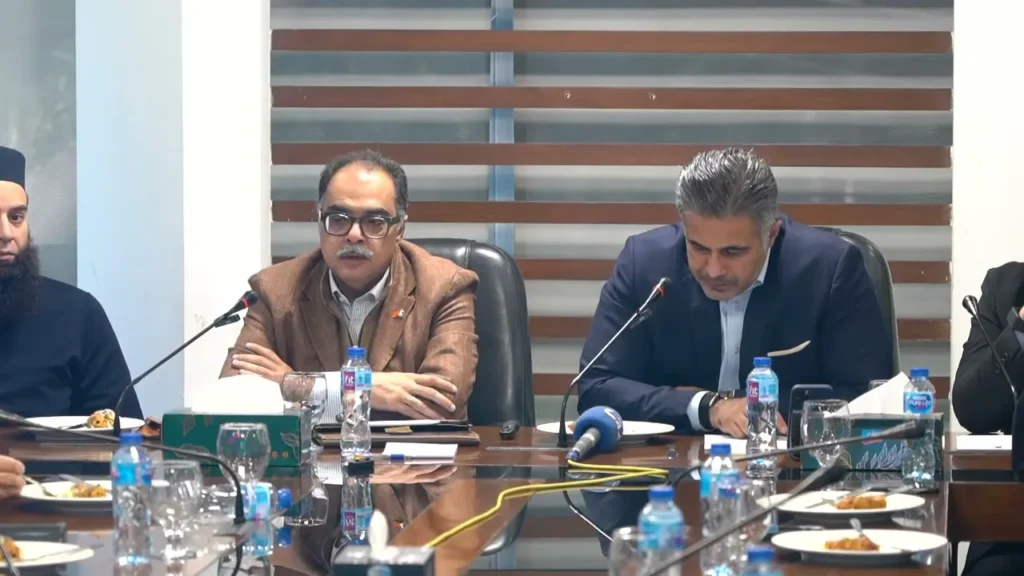
Zafar Masud, President & CEO of The Bank of Punjab, led a productive brainstorming session with APTMA to discuss the performance of Pakistan Textile Sector Financing and Exports, global export outlook, and the roadmap for sustainable growth.
A Strategic Dialogue: Pakistan Textile Sector Financing and Exports
Introduction: The Critical Junction of Finance and Industry
The brainstorming session led by Zafar Masud, President of the Bank of Punjab (BOP) and Chairman of the Pakistan Banks Association (PBA), with the All Pakistan Textile Mills Association (APTMA), represents a vital dialogue at a crucial juncture for Pakistan’s economy. The textile sector, APTMA’s core constituency, remains the backbone of the country’s export revenue and industrial employment.
This meeting was established on the fundamental premise of mutual learning and improved communication between the financial services sector and the industrial engine. Mr. Masud highlighted the paradoxical position of both the banking industry (PBA) and the textile industry (APTMA): both are often “quite misunderstood” despite their indispensable roles in national life.
The primary goal of this strategic engagement is to demystify operations, address deficiencies through honest communication, and forge a path toward collaborative assistance, moving beyond transactional relationships to true partnership in nation-building.
The State of the Economy and the Export Imperative
The conversation quickly pivoted to the fundamental driver of national stability: exports. Mr. Masud emphasized the unwavering principle that “all roads lead to exports.” In a macroeconomic landscape plagued by persistent fiscal deficits, debt management challenges, and the continuous need for foreign exchange stability, enhancing the export base is not merely a policy preference but an economic survival necessity.
The article’s detailed analysis would delve into the macroeconomic overview, starting with an in-depth exploration of Pakistan’s fiscal deficit, which, as noted by Mr. Masud, consumes a significant portion of national resources. This section would detail the composition of the deficit, the reliance on both external and domestic financing, and the structural impediments to revenue generation.
Concurrently, the discussion addressed the export deficit crisis, analyzing the chronic balance of payments challenges and the necessity for the banking sector to actively work towards improving its support mechanisms for export-oriented industries. The Pakistan Textile Sector Financing and Exports ecosystem is paramount here, as textiles contribute over 60% of total goods exports, making their success integral to the nation’s economic health.
See also: Pakistan – Trade, Debt & Poverty Reduction
The Banking Sector’s Indispensable Role and Misunderstandings
A critical part of the address was correcting the misconception of the banking industry’s role. While often viewed as profit-maximizing entities, Mr. Masud revealed the deep intertwining of the financial sector with the state’s day-to-day functions.
The banking industry’s financing support is the unseen backbone of the entire government machinery and public services. A stark warning was issued: if the banking sector were to withhold financing, the immediate consequence would be the cessation of essential services—“The lights that are on will switch off… the vehicles on the roads will stop”—because the entire system runs on this continuous support.
Furthermore, the article would detail the Bank of Punjab’s specific initiatives and future intentions, as promised by Mr. Masud, focusing on new financing products, risk management frameworks tailored for the textile sector, and programs designed to foster industrial growth within the region. This demonstrates a proactive approach to Pakistan Textile Sector Financing and Exports.
Addressing Macroeconomic Headwinds: The IMF Challenge
A candid assessment of Pakistan’s relationship with the International Monetary Fund (IMF) formed a significant part of the discussion. Mr. Masud was unambiguous in his view: “IMF is not to blame… the fault lies with us.” This is not an external problem but a reflection of internal governance and policy failures.
The core issue is the consistent inability to effectively handle, negotiate with, and implement the necessary structural reforms required by the IMF. Furthermore, a tendency exists to offload national responsibility onto the IMF, essentially letting them “shoulder the gun,” which ultimately harms national interests.
The policy implications for exports are significant: the conditionalities imposed by the IMF often have a direct bearing on the Pakistan Textile Sector Financing and Exports potential, influencing interest rates, energy tariffs, and the availability of export refinance schemes.
A Crisis of Geography: The Looming Threat of De-Industrialization in Punjab
The latter part of the session introduced a critical, geographical challenge facing Punjab’s industrial base, particularly the textile sector: the threat of de-industrialization. Industries, including major groups currently operating in Karachi’s industrial zones (Site and Landhi), are relocating to other provinces due to a massive disparity in renewable energy infrastructure. Sindh and Khyber Pakhtunkhwa (KP) possess advantageous wind corridors that Punjab lacks.
This energy exodus trend sees companies acquiring closed factories in areas like Nooriabad and investing substantially ($4-5 million) in captive wind and solar power generation. This shift is projected to reduce their energy costs by up to one-third over the next two to five years. Since energy is a primary input cost for textiles, this move creates an insurmountable competitive advantage for non-Punjab-based operations.
If this trend continues, Punjab, the traditional industrial heartland, will face the “brunt of de-industrialization” as factories and jobs migrate to areas with cheaper, sustainable power. This is a direct threat to the regional concentration of Pakistan Textile Sector Financing and Exports activity.
Pathways to Re-Industrialization: Energy & Policy Solutions
The solution requires a proactive, collaborative policy response, primarily led by the Government of Punjab (GoP), which Mr. Masud is actively engaged with. The central need is for the GoP to intervene to reverse the tide and facilitate re-industrialization by addressing the energy gap. This involves developing viable alternative energy infrastructure or creating policy incentives that mitigate the geographical disadvantage.
The banking sector, specifically BOP, can play a direct role by incorporating financing support for decentralized and captive power generation (solar/wind) into their long-term lending plans. This is a crucial element of future Pakistan Textile Sector Financing and Exports strategy, helping industries in Punjab achieve cost parity with their competitors in other provinces. The concept of Pakistan Textile Sector Financing and Exports must evolve to include “green financing.”
Conclusion: A Collaborative Vision for Growth
The BOP-APTMA brainstorming was less a formal meeting and more a candid acknowledgment of shared challenges and responsibilities. To secure the future, the banking sector must step up its support for Pakistan Textile Sector Financing and Exports, and the government must act swiftly to address the crippling energy cost disparity that threatens the industrial base of its largest province. Sustained communication, policy leadership, and targeted financial support are the three pillars on which Pakistan’s path to export-led stability must be built.
The Apex Body of Pakistan’s Economy: A Deep Dive into APTMA

The All Pakistan Textile Mills Association (APTMA) stands not merely as a trade organization but as a foundational pillar of the nation’s industrial and economic structure. Established formally under relevant trade ordinances, APTMA represents the entirety of the organized textile sector—a collective of over 400 textile mills that span spinning, weaving, and composite units across Pakistan.
The Association’s formation marked a necessary consolidation of industrial interests to effectively negotiate policy, address systemic challenges, and champion the growth trajectory of Pakistan’s largest industrial sector. It is affiliated with the leading chambers of commerce, ensuring its voice resonates at the apex of trade dialogue. The evolution of APTMA reflects the shifting dynamics of Pakistan’s economy, moving from initial import substitution efforts to becoming a dedicated, high-volume exporter. The core mission has always been to facilitate a policy environment conducive to sustained Pakistan Textile Sector Financing and Exports, recognizing that the industry’s health is directly proportional to the nation’s balance of payments.
The success of APTMA’s advocacy is measured in billions of dollars of foreign exchange earnings and millions of jobs supported nationwide, making its operational stability critical for the realization of ambitious targets set for Textile Sector Financing and Exports. The very definition of APTMA’s existence is rooted in facilitating the necessary mechanisms for robust industrial activity and securing the future of Textile Sector Financing and Exports.
The Undeniable Economic Magnitude of Textiles
The textile industry is unequivocally Pakistan’s economic linchpin. It is the country’s largest industrial employer, utilizing approximately 40% of the total labour force, and is the paramount source of export earnings, typically contributing over 60% of total goods exports. Pakistan boasts the status of the world’s fifth-largest cotton producer and is a major global exporter of textile products, underlining the raw material advantage and established manufacturing base that APTMA represents.
This immense scale requires specialized mechanisms for Pakistan Textile Sector Financing and Exports, which APTMA continually presses the government and banks to refine. The industry’s expansive value chain, stretching from basic ginning and spinning to highly specialized processing, weaving, and ultimately, value-added apparel, necessitates complex support. Historically, the sector’s performance has been a direct barometer of economic stability. For instance, following the adoption of competitive energy tariff policies, the sector experienced an extraordinary surge, attracting billions in new machinery and expansion investments and contributing to a record-high growth rate in South Asia. This period vividly demonstrated the catalytic effect of favorable policy on Pakistan Textile Sector Financing and Exports.
The goal, championed by APTMA, remains to unlock Pakistan’s full export potential, aiming for ambitious targets in textile exports. Achieving this target depends not only on production efficiency but crucially on comprehensive access to instruments of Pakistan Textile Sector Financing and Exports, including export refinance and long-term financing for modernization and expansion. When policies align, the sector responds with rapid capacity enhancement, directly translating into foreign exchange generation.
APTMA’s role is to ensure that macroeconomic distortions, such as interest rate volatility and excessive taxation, do not stifle the inherent capacity for strong Pakistan Textile Sector Financing and Exports. The sector’s inherent strength, fueled by the cotton supply chain, allows it to be a global powerhouse, provided the necessary support for Pakistan Textile Sector Financing and Exports is consistently in place. Any national strategy for growth must prioritize and safeguard the structures that support Pakistan Textile Sector Financing and Exports.
Policy Advocacy: Fighting for a Competitive Edge
APTMA’s most visible and critical function is its intense policy advocacy, centered primarily on achieving a regionally competitive environment. This involves continuous engagement with the Ministry of Commerce, Ministry of Finance, the national tax body, and key regulatory bodies responsible for energy pricing. The two primary areas of contention are energy and finance, both of which fundamentally determine the cost of production and the viability of Pakistan Textile Sector Financing and Exports.
The Energy Policy Imperative
The cost and consistent supply of energy—electricity and gas—is the single largest factor affecting the industry’s conversion cost. APTMA has successfully pushed for policies that offered fixed, competitive tariffs for export-oriented units. This policy was instrumental in the sector’s recent boom, proving that price-competitive energy is non-negotiable for competitive Pakistan Textile Sector Financing and Exports. The Association rigorously fights against erratic policy changes, such as the commitment to eliminate captive power generation from the gas sector, arguing that such a move ignores the ground realities of the industrial process and the necessity of uninterrupted, affordable power for production.
The long-term stability of the sector is directly tied to a predictable and competitive energy pricing structure, which forms the necessary base for any plan involving substantial Textile Sector Financing and Exports. The looming threat of de-industrialization in Punjab stems directly from this energy cost disparity. As industries move to other provinces with superior energy corridors and cheaper captive power solutions, APTMA faces the daunting task of convincing the government to introduce equivalent incentives in Punjab to protect the core industrial base dedicated to Pakistan Textile Sector Financing and Exports. Without policy commitment to energy parity, the industrial ecosystem built on Pakistan Textile Sector Financing and Exports faces fragmentation.
Financial and Trade Policy Frameworks
Beyond energy, APTMA champions a holistic, long-term approach to trade and finance policy. The Association repeatedly urges the government to enact a long-term Textile and Apparel Policy to encourage sustained capital investment. Such a policy must be supported by banks through long-term finance facilities for both direct and indirect exporters for building critical infrastructure, not just for plant and machinery. The continuous decline in Pakistan’s global textile and clothing export share necessitates an urgent revival of technological advantage, which can only be achieved through renewed investment backed by accessible Pakistan Textile Sector Financing and Exports.
Furthermore, APTMA plays a vital role in ensuring compliance with international conventions, especially concerning sustainability, labour, and human rights, which are prerequisite for market access, particularly in major international trading blocs. APTMA also actively engages with trade bodies to identify new export markets and remove technical barriers to trade, reinforcing the overall environment for effective Pakistan Textile Sector Financing and Exports. This multi-faceted advocacy is critical to ensuring the entire value chain remains competitive and can fulfill its potential in Pakistan Textile Sector Financing and Exports.
Strategic Engagement with the Financial Sector: The BOP Collaboration
APTMA’s relationship with the banking sector is defined by a necessary tension: the industry demands structural liquidity, competitive pricing, and responsive products, while banks navigate regulatory limits, fiscal shocks, and risk management. The high-level dialogue with the Bank of Punjab (BOP), led by its President and the Chairman of the national banks association, highlights a crucial recognition of mutual interdependence. The recent get-together was not merely a ceremonial meeting but a brainstorming session dedicated to creating a roadmap for sustainable export growth and improving the overall landscape of Pakistan Textile Sector Financing and Exports.
The Bank of Punjab’s Direct and Indirect Support
While the specific history of joint products or exclusive Memorandums of Understanding (MoUs) between APTMA and BOP might be intermittent, the recent engagement signifies a formalized, strategic push towards enhanced collaboration. BOP’s broader product portfolio demonstrates its commitment to the industrial sector, offering solutions which provide working capital, trade facilities, and term loans to the small and medium enterprises (SMEs)—the core constituency of the value-added textile sector.
Furthermore, BOP actively supports governmental and central bank initiatives related to exports, such as the Export Finance Scheme and refinancing schemes. BOP’s collaboration with the nation’s export-import bank to develop its business structure and extend its support to small exporters for equipment financing directly impacts the ability of APTMA members to secure necessary Pakistan Textile Sector Financing and Exports. The recent brainstorming session was a commitment from BOP to set up “sharper, more responsive financing solutions” aligned with industry needs, focusing on innovation in export and energy finance. APTMA, in turn, was urged to improve documentation and transparency to unlock credit further, fostering the adoption of efficiency, energy, and value addition upgrades that strengthen competitiveness.
This synergy is aimed at overcoming the traditional constraints in Pakistan Textile Sector Financing and Exports. For the sector to achieve its ambitious targets, the banking sector must step up its game in providing tailored instruments for Pakistan Textile Sector Financing and Exports. BOP’s focus on Pakistan Textile Sector Financing and Exports through digital and specialized products signals a proactive stance. The Bank of Punjab, recognizing the industry’s foundational role, is positioning itself as a key facilitator of Pakistan Textile Sector Financing and Exports, particularly in the context of the Punjab region’s specific challenges. The discussions emphasized a need for greater openness to new risk-sharing tools to boost Pakistan Textile Sector Financing and Exports across the country.
The Future Vision: Apparel Parks and Green Financing
The future strategy of APTMA centers on massive value addition and consolidation of manufacturing into modern industrial zones. APTMA leaders presented a vision for achieving ambitious textile exports, largely hinged on setting up garments plants through the creation of dedicated Apparel Parks. These parks are conceived as “Plug and Play” facilities equipped with state-of-the-art infrastructure designed to attract both local and international investors, mirroring successful models in other competing nations.
This vision has a profound implication for Pakistan Textile Sector Financing and Exports. The development of these apparel parks—which aim to boost annual export revenue significantly in the first phase—requires billions of dollars in infrastructure development and subsequent operational financing. APTMA has actively sought assistance from banks, including BOP, for the development of these parks, which will not only boost exports but generate millions of employment opportunities.
Crucially, the current energy crisis, characterized by the exodus of firms from Punjab, mandates that the banking sector embrace Green Financing. BOP’s willingness to incorporate financing support for decentralized and captive solar and wind power into their lending plans is a necessary evolution of Pakistan Textile Sector Financing and Exports, transforming it into a sustainable export-led growth model.
APTMA’s forward-looking strategy dictates that the entire support ecosystem, particularly the provision of Pakistan Textile Sector Financing and Exports, must pivot towards sustainability and industrial consolidation to remain globally relevant. The combined efforts of APTMA’s advocacy and BOP’s strategic lending are essential for fulfilling the industry’s potential and solidifying the nation’s economic future through robust Pakistan Textile Sector Financing and Exports.